Vaulting
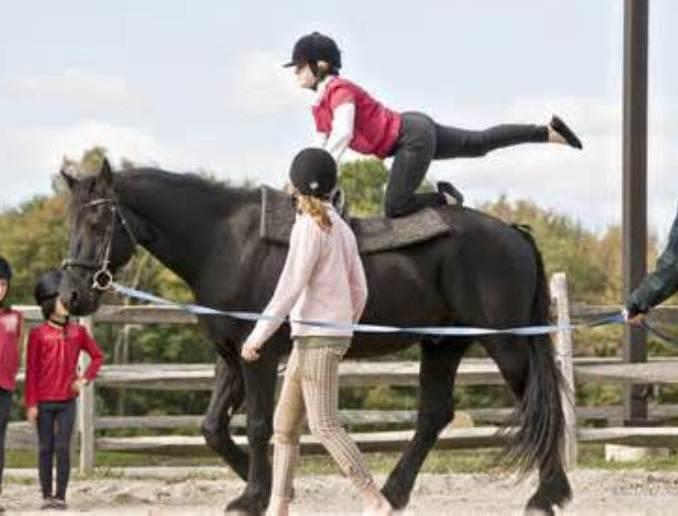
Vaulting is the word people reach for after hearing it in a club, a school program or a highlight reel, and it can mean three completely different sports. One is done on horseback, one in athletics, and one in gymnastics, and the equipment and risks barely overlap. The horse version is genuinely spectacular to watch: gymnastic movements performed on the back of a cantering horse guided by a handler on the ground. The catch is that the single word hides three separate skill sets. This guide maps each one, what you will see at training or competition, and the safety basics that matter when bodies are moving fast.
What "vaulting" usually means
The quickest way to avoid confusion is to sort the three by their setting. Equestrian vaulting is the horse-based discipline: gymnastic-style movements performed on the back of a horse that is usually cantering on a circle, guided by a lunger on the ground.1 It is its own sport under the FEI (Fédération Équestre Internationale), with individual, pair (pas-de-deux) and team formats.1
Pole vault is an athletics (track and field) event. Athletes sprint, plant the pole into a box and try to clear a bar at increasing heights.2
Gymnastics vault is an artistic gymnastics apparatus. Gymnasts run, take off from a springboard, contact the vaulting table with their hands, then fly and land under control.
History and a common mix-up
Equestrian vaulting is often traced back to ancient military training and horseback acrobatics, practices that evolved into organised sport over time.1 Modern competitive vaulting is governed internationally by the FEI.1
One point trips people up regularly. Equestrian vaulting is not a current Olympic sport. It appeared at the Olympics in 1920, but it is not part of the modern Olympic equestrian program, which is dressage, jumping and eventing.3
The three types, side by side
Equestrian vaulting (on a horse)
In competitive equestrian vaulting, athletes perform set and choreographed exercises on a horse moving on a circle, with a lunger maintaining a steady pace and line.1 Depending on level, the horse may be at walk or canter.
- Individual: one vaulter at a time, scored on compulsory and freestyle elements.
- Pas-de-deux: two vaulters working together for short sequences.
- Team: a squad, with limits on how many may be on the horse at once.1
Pole vault (athletics)
Pole vault is a height event with a simple objective: clear the highest bar. Athletes get up to three attempts at each height and can pass to a higher height, and three consecutive failures eliminate you.2 The pole is planted into a metal planting box at the end of the runway.2
Gymnastics vault (artistic gymnastics)
Gymnastics vault is performed on a vaulting table, the modern replacement for the older vaulting horse, with a run-up, take-off, a brief hand contact on the apparatus, then flight and landing.
Equipment by discipline
Equestrian vaulting
Equestrian vaulting uses horse and lunging gear, plus vaulting-specific tack designed for gripping and stability (commonly a surcingle) and an arena set-up that allows the horse to move safely on a circle.1 Most beginners start in structured sessions with a coach and an experienced horse accustomed to the work.
Pole vault
- Pole: modern poles are typically fibreglass or carbon fibre, chosen for the athlete's size, speed and strength.2
- Planting box: the metal box the pole is planted into at take-off.2
- Landing mats: large foam landing systems are standard because falls can be high and awkward.
Gymnastics vault
- Vaulting table: modern competition tables are height-adjustable and built to be stable under impact.4
- Springboard: for take-off and lift.
- Landing mats: placed to absorb force and reduce injury risk.
Physical demands and training
The common thread across all three is short, intense effort built on timing. Strength and speed matter, but so does the control that keeps joints stacked and landings safe.
- Equestrian vaulting: balance, coordination, grip strength, core stability, and the ability to adapt to the horse's rhythm.1
- Pole vault: sprint speed, take-off mechanics, upper-body strength, and aerial body control.2
- Gymnastics vault: explosive power, shoulder stability, spatial awareness, and consistent landing mechanics.
Good training looks fairly ordinary from the outside: lots of basics, plenty of rest, and a coach stopping things before fatigue turns technique into guessing. The staples are a warm-up for joints and landing mechanics (ankles, knees, hips, shoulders), strength and conditioning for the posterior chain, core and shoulders, skill progressions that isolate take-off, hand placement, swing or mounts and dismounts, and planned recovery. Fatigue is when awkward falls and sloppy landings tend to appear. On the mental side, the aim is not to erase nerves but to make them predictable, through repetition under supervision, a short and clear focus cue, and simple, specific corrections from video and feedback.
Safety and concussion basics
Most sessions are routine, but vaulting is still a sport where falls happen. Safety here is unglamorous: equipment checks, clear training spaces, and a willingness to stop early.
- Use a qualified coach and an appropriate training environment, especially for pole vault and gymnastics vault.
- Check equipment before each session: pole condition, mat placement, apparatus stability, and, for equestrian vaulting, horse and lunging gear fit and condition.1
- Keep the landing area clear of bags, bottles and stray gear.
If someone takes a knock to the head, or a blow to the body that jars the head, assume concussion is possible and remove them from activity for assessment. The Australian Sports Commission guidance is plain: if in doubt, sit them out, and do not let an athlete diagnosed with concussion return to play on the same day.5, 6 Some signs need urgent medical help, including neck pain, repeated vomiting, seizure, deteriorating consciousness, or weakness and tingling. If you see red flags, call an ambulance.7 In Australia, the most visible recent shift in sport safety has been clearer concussion recognition and return-to-sport guidance, which affects any discipline where falls and collisions can occur.5
The bottom line
Vaulting is not one thing. If you remember the horse, you are talking about equestrian vaulting. If you remember the runway and the bar, it is pole vault. If you picture a springboard and a table, it is gymnastics vault. Whichever one drew you in, the pattern is the same: a short burst of speed, a precise moment of contact, then the quiet business of landing well.
References
- Fédération Équestre Internationale (FEI), Vaulting (discipline overview)
- World Athletics, Pole vault (rules and event overview)
- Olympedia, Equestrian Vaulting (Olympic history)
- American Athletic, Inc. (AAI), ELITE Artistic Vault Table (apparatus overview)
- Australian Sports Commission, Concussion in Sport (guidelines and position statement resources)
- Australian Sports Commission, Concussion guidance (return-to-play principles and assessment tools)
- Australian Sports Commission, Concussion guidance for officials (red flags and actions)
- ABC News, AIS releases concussion guidelines for junior and community sport (31 January 2024)

Dog lover and writer at My Pets Australia, sharing practical breed guides and care advice for Australian pet owners.