Senegal Parrot
The Senegal Parrot is a small West African parrot, roughly 23 cm long, known for being a watchful, steady companion with a sharp mind and a strong personality packed into a compact body. It is quieter and less demanding than many larger parrots, which makes it a popular first medium parrot, though it still bonds hard and notices everything. In Australia these birds are kept as captive-bred pets, but whether you can legally own one depends on your state or territory and on how the bird was sourced, and importing one from overseas is tightly restricted under federal rules. Get the set-up and routine right and a Senegal is a genuinely rewarding bird. It is also a long commitment, often 20 to 30 years or more.1, 3
- Scientific name: Poicephalus senegalus2
- Adult size: about 23 cm long (varies by individual)2
- Typical adult weight: often around 120 to 170 g (varies with sex and condition)3
- Potential lifespan (captive): commonly 20 to 30 years or more, and some sources report longer with excellent care3, 4
- Noise level: can be loud in bursts (contact calls, excitement, alarm), especially at dawn and dusk3
- Trainability: generally high with gentle, consistent reinforcement3
History and Origin
Senegal Parrots come from parts of West Africa, where they live across open woodland and savanna. These landscapes give them trees for food and nesting hollows while keeping the canopy broken enough for easy flight between feeding sites.3
In captivity they are widespread, and Australia has an established population of captive-bred birds. If you are thinking about importing one, even a long-term pet, be aware that Australia's federal rules are strict: pet birds are generally limited to selected cases from New Zealand, and environmental and biosecurity requirements apply. For a bird already here, legality and availability still come down to your state or territory.5, 6, 7
Appearance and Physical Characteristics
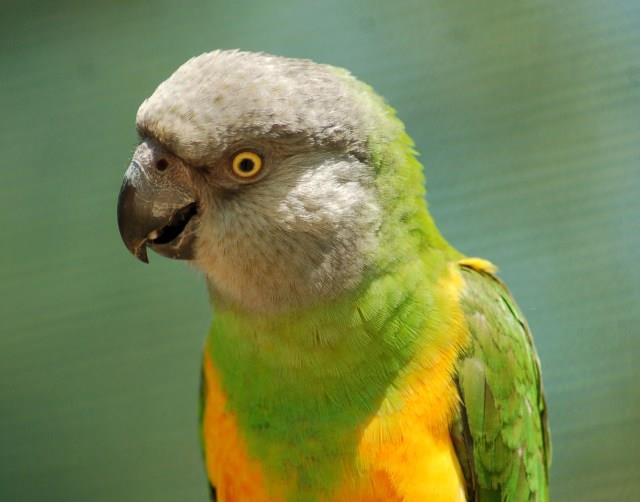
The Senegal Parrot is compact and solidly built, with a short tail and a strong, tidy beak made for cracking and stripping plant matter. Most birds show a green back and wings with a grey head, and the chest and belly carry a yellow to orange "vest" that looks brighter in good light. In still moments they can seem almost sculpted, then they move with quick, deliberate climbing steps when something catches their attention.2, 3
Like many parrots, they use the beak as a third hand. You will see it hook onto bars or branches as the feet shuffle forward, testing each grip before committing weight. It is normal behaviour, and it is one reason secure latches and safe household surfaces matter.3
Temperament and Personality
A Senegal communicates far more with its body than with words. It talks through posture, eye pinning, feather position and a wide range of calls. Some birds learn words and household sounds, but body signal is the more reliable language: a stiff posture, flared feathers or sudden stillness usually means "give me space", while relaxed feathers and steady footing mean the bird is comfortable.3
Noise tends to come in short, bright bursts, contact calls when you leave the room, alarm calls at sudden movement, or excited chatter when routines shift. It is not a constant screamer like some larger parrots, but it is not silent either. If noise is a deal-breaker in your living situation, hear the species in person before committing.3
Is a Senegal Parrot Right for You?
A Senegal suits people who want a watchful, active companion and can offer a stable routine rather than constant attention. It rewards structure: good food, a roomy set-up, daily time out of the cage, and training that keeps hands and beaks communicating safely. The birds bond strongly and live for decades, so this is a long relationship, not a passing pet.3, 8
Before you commit, check your state or territory rules on keeping one, and be honest about the noise and the lifespan. A bird that can outlive a mortgage needs a plan for the years ahead, not just the first few weeks.7
Care and Housing
A Senegal Parrot may be small, but it still needs room to climb, stretch and move between perches without squeezing past bowls and toys. Choose the largest cage you can sensibly fit, prioritising width and internal layout, with multiple perch heights and clear climbing lanes. Bar spacing should suit a small parrot, and doors need secure latches, because these birds learn mechanisms quickly.3
Inside the cage, rotate safe chewable items and foraging toys to keep the bird busy. Outside the cage, supervised time is where much of the exercise and social learning happens. A quiet routine of wake, feed, out time and rest often reduces screaming and helps a bird settle into the household rhythm.3
Diet and Nutrition
A Senegal Parrot's diet is easiest to get right when you aim for variety and steady nutrition rather than a single "main" food. Many avian vets and welfare organisations recommend a quality formulated pellet as the base diet, with vegetables and some fruit added daily, and seeds used more sparingly, often as training rewards, rather than as the staple.8
What to offer most days
- Pellets: a high-quality formulated diet appropriate for small or medium parrots (check brand guidance for amounts).8
- Vegetables: leafy greens, carrot, capsicum, broccoli, beans, peas and corn, rotated through the week.
- Fruit: offered in smaller amounts than vegetables, useful for variety and enrichment.
- Water: fresh daily, with bowls cleaned regularly.
Remove uneaten fresh food before it spoils, especially in warm weather. The goal is quiet consistency: steady energy, stable weight, and droppings that look normal for your bird. If weight drifts up or down, adjust portions and speak with an avian vet before making big diet changes.8
Training and Socialisation
Senegal Parrots often learn quickly when training is quiet and consistent. Short sessions, clear cues, and rewards that matter to the bird, such as a favourite seed, a small nut sliver or a toy, tend to work better than long sessions that push tolerance. Step-up training, stationing on a perch and calm crate travel are practical skills that reduce stress over a lifetime.8
Socialisation is less about constant handling and more about safe exposure: different people, household sounds, gentle changes in routine, and the confidence that "new" does not mean "danger". The best progress looks almost uneventful, steady, quiet acceptance rather than dramatic breakthroughs.8
Breeding and Nesting Behaviour
In the wild, Senegal Parrots typically nest in tree cavities. A clutch is commonly around 2 to 4 eggs, incubated by the female for roughly 25 to 28 days. After hatching, chicks remain in the nest for weeks, with fledging often around nine weeks and independence later again.1, 3, 4
If you are keeping pet birds, breeding should be deliberate, not accidental. Nest boxes and hormonal triggers such as long daylight hours, rich foods and dark "nesty" spaces can change behaviour quickly, sometimes bringing territorial biting or chronic egg-laying risks. If breeding is not the goal, avoid providing nest-like hideouts and talk with an avian vet if egg-laying starts.8
Health and Lifespan
Many Senegal Parrot problems start as small shifts: a bird that eats but drops weight, a bird that sits fluffed for longer than usual, or a bird that chews feathers when routines change. Obesity can develop when seeds and fatty treats become the default, while stress and boredom can fuel feather damage and behavioural issues. With good care, these birds commonly live 20 to 30 years or more.3, 8
A few high-priority red flags
- Breathing with an open beak at rest, tail bobbing, or an audible wheeze
- Sudden fluffed posture, sleepiness, or sitting low on the perch
- Marked drop in appetite or water intake
- Persistent vomiting or regurgitation not linked to normal bonding behaviour
- Blood in droppings, or droppings that change dramatically for more than a day
If any of these appear, treat it as a same-day avian vet problem. Birds hide illness, so by the time signs are obvious they may already be unwell.8
Psittacine beak and feather disease (PBFD)
PBFD is a serious viral disease caused by a circovirus and is recognised across many parrot species. It can cause abnormal feather growth and immune suppression, and it spreads through feather dust and other secretions. Testing and quarantine for new birds are key controls in multi-bird homes.9
Conservation Status
The Senegal Parrot is listed as Least Concern on the IUCN Red List. Even so, local pressures can still matter, especially habitat change and capture for trade in parts of its range, threats that do not always show up clearly in a single global status label.3
The Bottom Line
A Senegal Parrot suits people who like a watchful, active companion and can commit to a stable routine: good food, a roomy set-up, daily time out of the cage, and training that keeps hands and beaks communicating safely. Check your state or territory rules before you buy, and plan for a bird that may share the next two or three decades with you. Done well, the care becomes simple, the bird's world stays predictable, and its curiosity has somewhere to go.8
References
- Encyclopedia of Life (EOL), Senegal parrot (Poicephalus senegalus) articles
- Animal Diversity Web, Poicephalus senegalus (Senegal parrot)
- IUCN Red List of Threatened Species, Senegal parrot (Poicephalus senegalus)
- Animal Diversity Web, longevity and reproduction notes for Poicephalus senegalus
- Australian Border Force, Live animals and pets (what you can and cannot bring in)
- Australian Government (DAFF), Importing your pet bird
- Australian Government (DCCEEW), Live Import List (updated 27 January 2026)
- Association of Avian Veterinarians, avian welfare and care resources
- Merck Veterinary Manual, viral diseases of pet birds (PBFD overview)

Dog lover and writer at My Pets Australia, sharing practical breed guides and care advice for Australian pet owners.