Red Bellied Parrot - Orange Belly Parrot
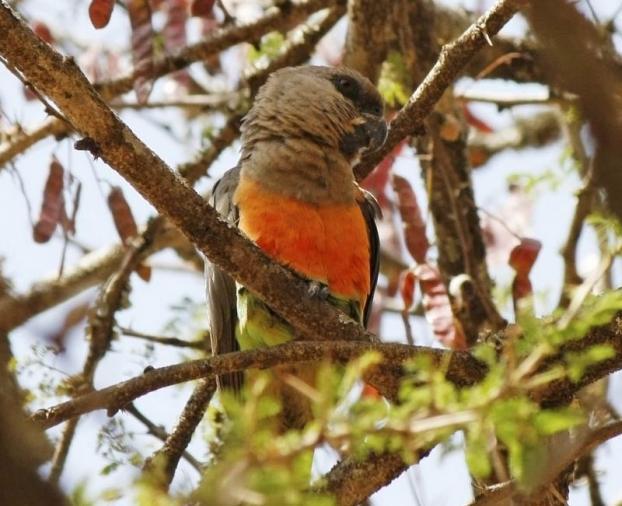
If you have spotted a green parrot with a warm-coloured belly and want to put a name to it, this is the guide for you. Two very different Australian birds get tangled up under the label "red-bellied parrot", and telling them apart is genuinely useful. One is the Red-rumped Parrot, a common bird you will see around farms, plains and parks. The other is the Orange-bellied Parrot, a critically endangered migrant with tightly protected breeding and wintering grounds. Get the two confused and you risk treating a threatened wild species as though it were a backyard pet, which it is not.
These are not the same bird
Start with the plain fact: there is no Australian species properly called the "Red-bellied Parrot". What people usually mean is the Red-rumped Parrot (Psephotus haematonotus), a widespread inland bird with a red rump rather than a red belly. The Orange-bellied Parrot (Neophema chrysogaster) is a separate species in a different genus: smaller, migratory and critically endangered.1, 2, 3
Quick identification in the field
- Bright red patch on the lower back or rump, often flashing in flight, on a mostly green parrot in open grassy country: that is almost certainly a Red-rumped Parrot.1
- A small parrot with a distinct orange belly patch and blue on the face and wings, near coastal saltmarsh in Victoria or South Australia in autumn or winter: treat it as a possible Orange-bellied Parrot and report the sighting through local channels, such as your state environment department's reporting pathways.2, 4
The Red-rumped Parrot
This is the bird most "red-bellied" enquiries are really about, and it is easy to enjoy. Red-rumped Parrots are slim, medium-small parrots around 27 cm long. Adult males are mostly green with a vivid red rump, while females are duller and usually lack the bright rump patch.1, 5
It is a bird of open grasslands, lightly timbered plains, farmland and watercourses across inland and south-eastern Australia. It is not a coastal specialist, and it is not a long-distance migrant.5, 6 In the wild it feeds mostly on the ground, taking grass seeds and other plant material, with some feeding in shrubs and trees as conditions change.5, 6
Red-rumped Parrots typically nest in hollows, often in eucalypts, and will also use posts or other cavities. Clutch sizes are commonly reported at around 4 to 6 eggs, and breeding can happen across a broad season depending on conditions.5, 6
The Orange-bellied Parrot
The Orange-bellied Parrot is one of the rarest parrots on earth, and it is a wild conservation animal, not a pet. It is a small, bright green grass parrot with a yellowish chest and a clear orange patch on the belly, around 20 to 21 cm long and roughly 40 to 50 g, noticeably smaller and lighter than many common backyard parrots.2, 4
It is also one of only a few migratory parrots in the world. It breeds in south-west Tasmania, at Melaleuca and the surrounding country, in spring and summer, then crosses Bass Strait to spend autumn and winter along the coasts of Victoria and South Australia, usually staying very close to the shoreline in suitable habitat.2, 7 On the mainland it is strongly tied to coastal saltmarsh and nearby weedy pastures, where it forages for the seeds of salt-tolerant plants and other low vegetation.2, 7
The species is listed as Critically Endangered under Australia's national environment law, the EPBC Act. Its recovery relies on coordinated habitat protection and intensive management, including captive breeding and releases.4, 8
Common misconceptions, corrected
- "The Orange-bellied Parrot is a type of Red-rumped Parrot." False. They are different species in different genera.1, 2
- "Both are threatened species." False as a blanket statement. The Orange-bellied Parrot is Critically Endangered; the Red-rumped Parrot is widespread and not nationally listed as threatened.4, 6
- "These are popular pet birds in Australia." Misleading. The Orange-bellied Parrot is a threatened wild species managed under conservation programs, not a normal pet bird, and discussing it as a pet option is inappropriate.4, 8
If you think you have seen an Orange-bellied Parrot
Take notes rather than chasing the bird. The details that matter are the exact location, the date and time, the flock size, the behaviour (feeding on saltmarsh plants or in adjacent pasture), and any photos taken from a distance. In Victoria, official information pages also set out where the species typically occurs and why sightings matter.2
The bottom line
If the red is on the rump and the bird is out on grassy inland country, you are looking at a Red-rumped Parrot, a common and unthreatened species. If the orange is on the belly and the bird is on coastal saltmarsh in the south in the cooler months, you may have found something far rarer that belongs to conservation programs, not to a cage. When in doubt, note the details and report it.
References
- World Parrot Trust, Red-rumped Parrot (Psephotus haematonotus)
- Victoria DEECA, Orange-bellied Parrot species information
- Department of Natural Resources and Environment Tasmania, About Orange-bellied Parrots
- Australian Government (DCCEEW), Orange-bellied Parrot (EPBC status and overview)
- Birds in Backyards (BirdLife Australia), Red-rumped Parrot
- Biodiversity of the Western Volcanic Plains (Vic), Red-rumped Parrot field guide entry
- Australian Government (DCCEEW), National Recovery Plan for the Orange-bellied Parrot (2016; page updated 2021)
- ABC News (31 March 2025), reporting on Orange-bellied Parrot genetic diversity and conservation options

Dog lover and writer at My Pets Australia, sharing practical breed guides and care advice for Australian pet owners.