Scarlet Macaw
The Scarlet Macaw (Ara macao) is one of the most striking parrots in the world: brilliant red with yellow and blue wings, highly intelligent, and capable of learning to mimic human words. These birds bond closely with their people and can be affectionate, playful companions in the right home. They are also long-lived, with captive birds often reaching several decades and sometimes 50 to 70 years or more.3 That longevity is part of the appeal and part of the challenge, because a scarlet macaw is a serious, decades-long commitment with real needs for space, noise tolerance, diet, and veterinary care. Kept well they are remarkable. Kept badly they become loud and destructive very quickly.
History and Origin
Scarlet macaws are native to Mexico, Central America, and large parts of northern South America, especially the humid lowland forests near rivers and big trees.1 In the wild they move through the upper canopy in pairs and small groups, travelling to feeding areas during the day and returning to communal roosts. They keep in contact with each other across dense forest by calling, so sound is a normal part of how they live rather than a bad habit.5
Understanding that natural behaviour explains a lot of what a macaw does indoors. The same drive to call, chew, climb, and stay involved in the group shows up as constant interest in whatever the household is doing. A bird left without structured activity will usually invent its own, generally using timber, metal fittings, curtains, or anything else within reach.
Appearance and Physical Characteristics
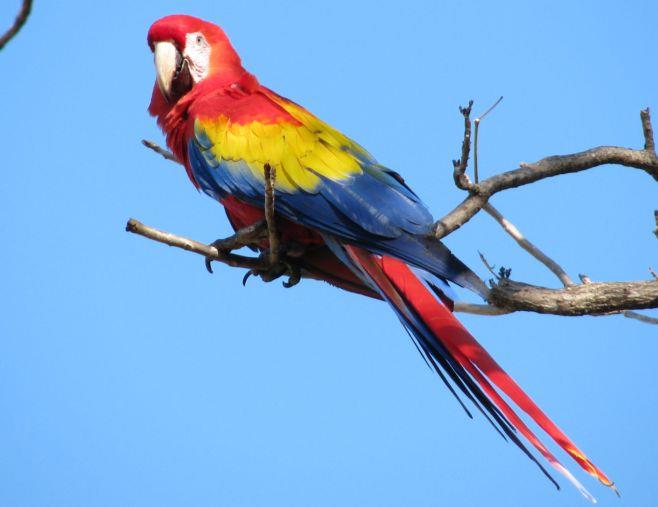
Scarlet macaws are vivid red overall, with yellow across the upper wing coverts and deep blue on the flight feathers and tail. The face carries a bare white patch marked with fine feather lines, and the beak is pale on the upper mandible and darker on the lower one.2 Adults measure roughly 81 to 96 cm from head to tail tip, with the long tail making up more than half of that total length.2
Juveniles look much like adults. With age, birds commonly develop pale yellow irises, while younger birds tend to have darker eyes.2
Temperament and Personality
Scarlet macaws can be affectionate and highly interactive, but they are not naturally easy. Most do best with predictable routines, clear boundaries, and daily chances to forage, chew, climb, and train. They notice every change in the household and respond to it.
Behaviour that gets described as jealousy is usually better understood as a shift in routine and attention. When a bird gets less interaction, less training, and fewer predictable moments, it often escalates calling or demanding behaviour because that has worked before. The answer is rarely punishment. It is structure, enrichment, and consistency. Individual birds also vary in whether they take to mimicking human sounds and words, so talking ability is never guaranteed.
Is a Scarlet Macaw Right for You?
For most households, honestly, this is not the right bird. Scarlet macaws are loud, with carrying calls and daily vocal periods that a quiet home or close neighbours will not absorb. They need space to move and fully extend their wings, hours of interaction, an avian vet within reach, and an owner prepared for a companion that may outlive a mortgage or a career.
They suit experienced, highly committed keepers with room, time, and money for the long haul. In small rooms, with long days alone and neighbours nearby, a scarlet macaw tends to become persistently noisy and destructive, and its welfare can slide fast. In Australia these birds are uncommon. Importing pet birds into Australia is tightly restricted, generally only permitted from New Zealand under specific conditions, so local birds usually come from existing captive lines.4 If you are choosing between one macaw and no macaw, visit experienced keepers first, ask an avian vet about long-term costs, and be honest about how much you are actually home.
Care and Housing
A scarlet macaw is not a cage-only animal. Even a large, sturdy cage is best treated as a safe base rather than a full-time home, with daily supervised time out for exercise. The priority is room to move, climb, and fully stretch the wings.
- Strength: heavy-gauge stainless steel or high-quality powder-coated construction. Macaws can deform weaker bars and destroy fittings with sustained chewing.5
- Locks and latches: simple clips are rarely enough, so use secure, bird-safe latches.
- Perches: offer mixed diameters and textures, and avoid relying on abrasive sand covers, which can irritate the feet.
- Enrichment: rotate chewable wood, cardboard, bird-safe rope, and foraging toys, and expect to replace them often.
If you keep a macaw outdoors, design for weather protection against wind, rain, and heat, plus night security. In many parts of Australia, snakes can enter poorly protected aviaries, so build with predator-proof mesh, secure joins, and close attention to gaps at ground level.
Diet and Nutrition
Most pet macaws do best on a balanced base of quality formulated pellets, supported by a wide variety of vegetables and smaller amounts of fruit, nuts, and seeds. All-seed diets are a common pathway to malnutrition and obesity.6
- Use sturdy bowls. Stainless steel is usually worth it.
- Vegetables first: dark leafy greens and orange vegetables such as capsicum, pumpkin, and sweet potato make useful staples.
- Nuts and seeds: best used as training rewards and foraging items rather than an unlimited bowl.
- Avoid avocado: it is toxic to birds.6
Grooming and Care
Many macaws bathe often when given the choice. Offer a shallow bath dish or gentle misting, and make sure the bird can dry afterwards in a warm, draught-free space. Regular bathing helps reduce dust and keeps feathers in good condition.
Healthy beaks and nails are usually maintained through daily chewing and climbing, so provide safe branches, destructible wood, and varied perches. If the beak or nails become overgrown or misshapen, that is a job for a vet, not a DIY project.
Wing clipping is a careful topic. It can reduce lift and make escape less likely, but it can also raise the risk of crash injuries and change how a bird copes with stress. If you are considering it, have it done by an avian vet or under vet instruction using a conservative approach that preserves controlled descent where possible, and review household hazards first, including doors, windows, and ceiling fans.7
Health and Lifespan
Parrots are experts at hiding illness until they can no longer manage it. Subtle changes are enough reason to call an avian vet promptly: quieter behaviour, fluffed feathers, reduced appetite, sitting low, altered droppings, or tail-bobbing with breathing. Hygiene matters because many pathogens spread through droppings, feather dust, and contaminated surfaces, so clean food and water bowls daily, remove spoiled fresh food quickly, and keep the cage dry and well ventilated.
Psittacine beak and feather disease (PBFD) is a highly infectious viral disease of parrots. Signs can include abnormal or missing feathers and overgrown or deformed beak and claws. It can persist in the environment and spreads through feather and faecal material, among other routes.8, 9 If you keep parrots, talk to your vet about risk reduction, quarantine for new birds, and testing where appropriate, especially before introducing a new parrot to an existing household.
With excellent care, captive scarlet macaws often live for several decades and may reach 50 to 70 years or more.3
A Few Things Worth Knowing
- Scarlet macaws are sexually monomorphic, meaning males and females look alike, so telling them apart commonly requires DNA testing.10
- Breeding is not a casual extension of keeping. Even with a compatible pair, doing it responsibly needs specialised housing, nest provision, diet management, careful chick-rearing decisions, and a plan for lifelong outcomes. Approach it with professional mentoring, veterinary support, and a clear understanding of your state or territory requirements.
- Talking ability varies widely between individuals, so buy the bird in front of you, not a mimicry promise.
- Ownership and movement of exotic birds can depend on state and territory law, so check your local wildlife authority before you commit.
The Bottom Line
A scarlet macaw can be a genuinely rewarding companion for the right keeper: experienced hands, patient training, plenty of enrichment, and enough space that the bird can simply be a bird. It is also a loud, long-lived, demanding animal that punishes a poorly planned setup. If you can meet the commitment for the full length of its life, few pets are more spectacular. If you cannot, both you and the bird are better off without one.
References
- U.S. Fish & Wildlife Service, Scarlet Macaw (Ara macao) overview and habitat
- Wildlife North America, Scarlet Macaw (Ara macao) facts (size and identification)
- Buffalo Zoo, Scarlet Macaw facts (longevity in captivity)
- Australian Department of Agriculture, Fisheries and Forestry, Importing your pet bird (psittacines, restrictions and permits)
- San Diego Zoo Wildlife Alliance, Macaw behaviour, grouping and daily movement
- Merck Veterinary Manual, Nutrition of companion birds (pellets, fresh foods, toxic foods)
- The Unusual Pet Vets (Australia), Wing clipping overview and technique considerations
- BirdLife Australia, What is psittacine beak and feather disease (PBFD)?
- Wildlife Victoria, PBFD fact sheet (signs and prevention)
- Lincoln Park Zoo, Macaw facts (sexes look alike, general species notes)

Dog lover and writer at My Pets Australia, sharing practical breed guides and care advice for Australian pet owners.