Red Lored Amazon
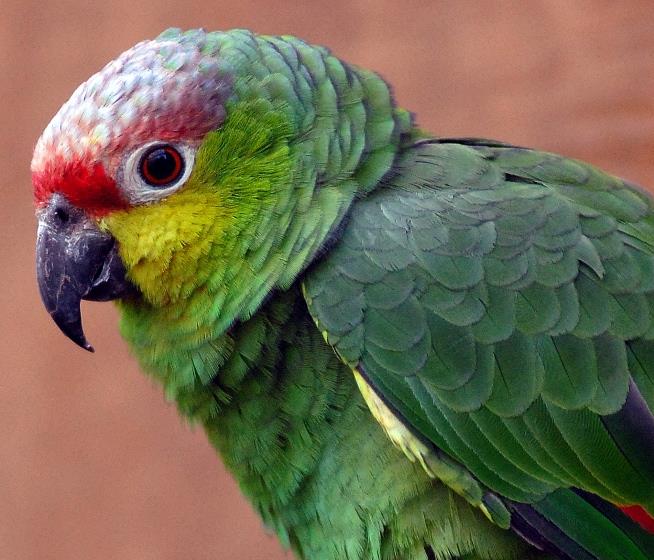
The Red-lored Amazon (Amazona autumnalis) is a stocky green forest parrot with a red forehead, a powerful beak and a quick, curious mind. It is a genuinely engaging companion bird: sociable, capable of mimicry, and often bonded closely to the people it trusts. It is also a very long commitment, with well cared-for birds living 40 years or more. In Australia the birds you see are captive-bred, because live-bird import is tightly controlled. Get the daily routine right, food, space, light, sleep and steady contact, and this is a bird that thrives; get it wrong and you get a loud, frustrated, unhealthy parrot instead.
Appearance and Physical Characteristics
In good light the Red-lored Amazon reads as mostly green, set off by the red forehead and lores (the small patch between eye and bill) that give the bird its name. Many individuals show yellow on the cheeks, with blue washing through the crown and some wing and tail feathers. Adult males and females look alike, while juveniles usually show less red and yellow and darker eyes.1, 2
At a glance:
- Scientific name: Amazona autumnalis1
- Adult size: about 32 to 35 cm long1, 2
- Adult weight: roughly 314 to 485 g, varying with sex, subspecies, diet and condition1
- Typical lifespan in captivity: commonly several decades with good care, 40 years and beyond is realistic3
- Natural range: southern Mexico through Central America into northern South America, plus Trinidad and Tobago1, 2
Temperament and Personality
These are social parrots with a strong drive to engage with everything around them. With consistent handling and predictable routines they become confident, interactive companion birds. Without enough stimulation that same energy goes into screaming, chewing and repetitive behaviour. They are often capable mimics, though speech varies widely between individuals and is best treated as a bonus rather than a promise.
Noise is the honest catch. All Amazons can be loud, particularly at dawn and dusk, and in a suburban setting that predictable call time is often what decides whether the species suits the household.
Is a Red-lored Amazon Right for You?
For a lot of households, honestly, the noise and the timeframe rule it out before anything else does. This is a decades-long relationship with a bird that will call loudly at set times most days, so the question is whether your home and your neighbours can live with that for the long haul.
There is also the legal side. Australia tightly controls the import of live birds, and for household pets the options are limited, requiring permits under both biosecurity and environment law, with only certain pathways (such as from New Zealand) potentially available at all.7, 8, 9 In practice that means any Red-lored Amazon you buy here should be a legally sourced, captive-bred bird with clear paperwork. Rules also vary by state, so check your state or territory authority before you commit.
Prices vary by state, availability, age, and whether the bird is properly weaned, banded or microchipped, and accompanied by paperwork. A price that looks unusually low is a cue to ask more questions, not to hurry. Before you commit, run through these checks:
- Can you handle a loud bird at set times most days?
- Do you have a local avian vet and a plan for emergencies?
- Is your diet plan pellet-based, with daily fresh vegetables and measured treats?
- Is the bird's history clear, covering age, source, leg band or microchip where applicable, and any prior health issues?
Care and Housing
This is a parrot built for climbing, chewing and long stretches of alert stillness broken by bursts of activity, and the enclosure has to match that. The essentials:
- Space: a large cage with room to fully extend the wings, plus daily out-of-cage time in a safe area.
- Perches: mixed diameters and textures, with natural branches useful, to reduce pressure points on the feet.
- Chew outlets: safe wood, cardboard and foraging toys, rotated regularly to keep interest steady.
- Sleep: a consistent, dark, quiet sleep period, which helps reduce irritability and noise.
In the wild the species uses a mix of forest types, from humid and drier woodland edges to tall forest and sometimes cultivated areas with fruiting trees.1, 2 The captive version of that is variety and occupation: things to shred, places to climb, and food that takes effort to reach.
Diet and Nutrition
Diet is where most companion Amazons quietly go wrong. Wild Red-lored Amazons feed mainly on plant material, fruits, seeds, nuts, blossoms and buds, taking what is seasonally abundant.1, 3 The goal at home is steady nutrition without drifting into an all-seed pattern, which tends to be energy-dense and nutritionally uneven. A practical approach:
- Base diet: a quality formulated pellet as the mainstay.
- Daily fresh foods: a rotating mix of vegetables, especially dark leafy greens and orange vegetables for carotenoids, plus fruit in smaller amounts.
- Seeds and nuts: best used as measured treats and training rewards, not the bulk of the bowl.
- Foraging: hide portions of the daily ration in foraging toys and safe tear-and-shred materials to slow eating and occupy the beak.
This is less about perfection and more about preventing the common slide into high-fat, low-variety feeding. Studies in Amazon parrots show that birds offered mixed diets of seed, produce and pellets may still self-select foods that leave the overall diet too fatty and short on key nutrients, whereas lower-seed patterns improve the balance.5, 6 Provide fresh water daily, clean bowls routinely, and store seed and nuts carefully, since poorly stored seed and peanuts can carry toxins that damage the liver.3
Health and Lifespan
Most problems in companion Amazons trace back to diet, inactivity and long-term low-grade stress rather than sudden illness. Watch for slow changes: weight creep, less flying and climbing, feather damage, or a bird that becomes unusually quiet. The two most common and most preventable risks are:
- Obesity and fatty liver (hepatic lipidosis): more likely in sedentary birds on high-seed, high-fat diets.3
- Vitamin A deficiency (hypovitaminosis A): historically common in parrots on seed-heavy diets, affecting the respiratory and digestive tract and overall immunity.3
Birds hide weakness well, so do not wait for dramatic symptoms. Early veterinary assessment usually changes the outcome, which is one reason a local avian vet belongs on your checklist before the bird arrives. With good care, lifespans of 40 years and more are realistic.3
A Few Things Worth Knowing
- In the wild the species nests in tree hollows. In managed breeding, clutches are commonly a few eggs, with incubation around the high 20s in days and chicks dependent for weeks after hatching. Exact timing varies and is best guided by an experienced aviculturist and an avian vet.2
- Across the Amazon parrot group the major pressures are habitat loss and trapping for trade.4
- Conservation listing and taxonomic treatment differ between authorities and change over time, so rely on current, primary listings whenever permits or cross-border movement are involved.4
The Bottom Line
The Red-lored Amazon is a bright, sociable, long-lived parrot that rewards owners who can give it space, occupation and a proper pellet-based diet. It is not a low-effort pet: it is loud at predictable times, it lives for decades, and in Australia it must be a legally sourced captive-bred bird, with import tightly controlled and rules that vary by state. If a large, vocal, high-engagement bird fits your household and you have an avian vet lined up, few companion parrots give back more.
References
- World Parrot Trust, Red-lored Amazon (Amazona autumnalis)
- Animal Diversity Web (University of Michigan), Amazona autumnalis
- Merck Veterinary Manual, Nutrition in Psittacines
- IUCN Red List of Threatened Species, search listing for Amazona autumnalis
- Journal of Avian Medicine and Surgery (via PubMed), Nutritional levels of diets fed to captive Amazon parrots
- Seminars in Avian and Exotic Pet Medicine, Veterinary nutrition of large psittacines
- Australian Government (DAFF), Importing your pet bird
- Australian Government (DAFF), Bringing or mailing goods to Australia (live animals and pet birds)
- Australian Government (DCCEEW), Wildlife trade permits: Do I need a permit?

Dog lover and writer at My Pets Australia, sharing practical breed guides and care advice for Australian pet owners.