Quaker (Monk) Parakeet
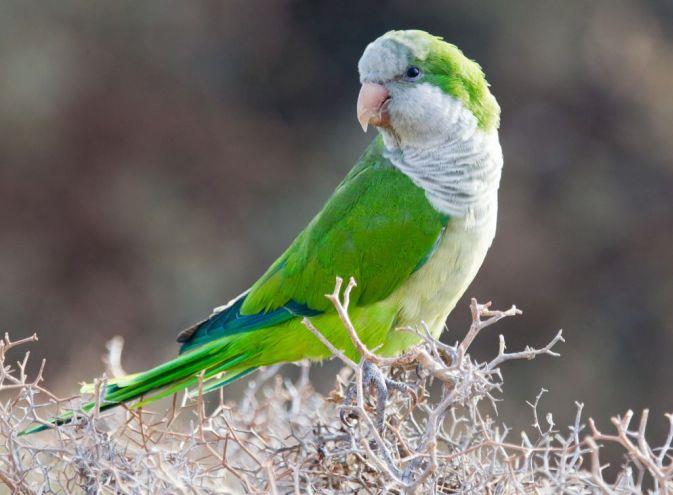
The Quaker parakeet, also called the monk parakeet (Myiopsitta monachus), is a compact green South American parrot known for being alert, sociable and quick to learn routines. It is one of the few parrots that builds its own bulky stick nest instead of nesting in tree hollows, and that single habit shapes almost everything about how the species is viewed. In Australia the picture is complicated. Monk parakeets are treated as a serious pest in some states, and whether you can legally keep one depends on where you live, so the first step is always to check your state authority before anything else. What follows is a grounded profile of the bird: how it looks and sounds, where it lives, how it breeds, what it eats, and the practical realities in an Australian context.
Quaker (monk) parakeet: quick facts
- Common names: Quaker parakeet, monk parakeet, monk parrot
- Scientific name: Myiopsitta monachus
- Adult size: about 29 cm long, wingspan around 48 cm1
- Adult weight: often around 90 to 130 g (varies by sex and population)1, 2
- Colour: mostly green with a pale grey face and greyish breast, with blue tones in the flight feathers and tail1
- Voice: loud, busy chatter with sharp squawks, often the first clue they are nearby2
- Global conservation status: Least Concern (IUCN)3
Appearance and Physical Characteristics
At a glance, a Quaker parakeet is a compact, long-tailed green parrot with a pale grey bib across the face and upper chest. In good light you can catch cooler blue tones in the wings and tail. The beak is stout and usually pale orange to horn-coloured, built for cracking seed and stripping plant material.1
In groups they move with purpose, flying fast and direct between feeding spots and nest sites while calling constantly to keep contact. The sound carries further than the bird itself, especially in built-up areas.2
History and Origin
Quaker parakeets are native to temperate and subtropical South America. They have also established wild, self-sustaining populations in parts of North America and Europe, largely through escapes and releases from the pet trade.1
They cope well with human-altered landscapes such as parks, streetscapes, orchards and farm edges, as long as there is food and somewhere to build. Their nesting style is the key difference. Instead of using tree hollows like many parrots, they build large stick nests that can grow into multi-chambered structures resembling apartment blocks.1, 4
In Australia, Quaker parakeets are mainly encountered as captive birds rather than as widespread wild populations. Requirements vary by state and council area, and some jurisdictions focus heavily on secure housing and preventing release, because a few birds in the wrong place can become a long-term problem.4
Temperament and Personality
Quaker parakeets are strongly social. In the wild they gather in flocks and coordinate movements with constant calls, and the same wiring shows up in captivity. Many individuals want frequent interaction, and they notice routines, voices and small changes in their environment.1
They are also capable builders. Given access to sticks, a bird may try to renovate its enclosure, wedge material into corners, or construct dense piles. This is normal behaviour, but in a house it can turn into persistent chewing and rearranging, particularly if the bird is bored or under-stimulated.
Some Quakers learn words and household sounds, but the more reliable trait is volume. Their natural contact calls are loud, and they often vocalise at sunrise, during excitement, or when they feel separated from the action.2
Is a Quaker Parakeet Right for You?
Legality comes first. In parts of Australia the monk parakeet is managed as a pest rather than welcomed as a pet, so whether you can keep one, and under what conditions, depends on your state and council rules. Check your state biosecurity or wildlife authority before you plan anything.4 On top of that, importing pet birds into Australia is tightly controlled, and for most people only certain movements, such as from New Zealand under specific conditions, may be possible.8, 9
Where it is legal to keep one, a Quaker can be a deeply engaging bird: alert, active, quick to learn patterns and often keen to interact. It is not a low-maintenance pet. Plan around noise, chewing and a daily need for enrichment, and treat it as a commitment that can run for decades rather than a short project.2, 7
Suits: people who want an interactive, trainable bird, can tolerate loud morning calls, and can supervise a strong chewer.
Does not suit: households needing a quiet or hands-off pet, or anyone who has not first confirmed the bird is legal to keep where they live.
- Noise: natural calls are sharp and persistent, especially in the morning and when the bird is excited.
- Destructiveness: strong chewing and building instincts mean furniture, cords and timber trims can suffer without supervision and safe outlets.
- Territorial moments: some birds become possessive of cages, nest-like spaces or favourite people, so management and training matter.
Diet and Nutrition
In the wild, Quaker parakeets feed on a mix of seeds, fruit, buds, shoots and other plant material, changing with the season and local availability. In agricultural areas they may target grain and orchard crops when the timing suits them.4
In captivity, aim for a balanced base diet rather than an all-seed mix:
- Most days: formulated parrot pellets of an appropriate size as the main ration.
- Daily additions: vegetables and leafy greens, with small serves of fruit.
- Limited extras: seed and nuts as treats or training rewards, since they are energy-dense and easy to overdo.
- Water: fresh daily.
For calcium support, many keepers provide a cuttlebone or mineral source, but diet planning is best done with an avian vet, especially for breeding birds or birds with a history of egg-laying issues.5
Breeding and Nesting
In suitable conditions, Quaker parakeets commonly nest once a year. Clutch size is often in the range of 4 to 7 eggs, and incubation is roughly three weeks, though timing varies with conditions and between sources.6, 4
The standout feature is the nest itself, a large communal stick structure with multiple chambers. These nests can be built in trees, but also on human structures, especially power poles and substations, where the warmth and stable platforms suit them all too well.1, 4
Why They Are Treated as Pests in Some Places
In parts of their introduced range, Quaker parakeets are managed as pests largely because of their nest-building. Heavy stick nests on power infrastructure can cause outages, equipment damage and fire risk. The birds can also raid crops and compete with local species in certain settings, depending on habitat and food availability.4
Conservation Status and the Bigger Picture
Globally, the species is listed as Least Concern, which means it is not currently considered close to extinction at a global scale. That does not cancel out local problems. In some places it is protected wildlife, in others it is controlled as an invasive species, and both can be true depending on where the birds are living and what they are doing there.3
The Bottom Line
The Quaker parakeet is a bright, sociable, long-lived parrot with a genuine talent for interaction, and also a documented pest wherever its stick nests meet power lines and crops. In Australia that dual reputation is the whole story: your first job is not choosing a cage, it is confirming with your state authority whether keeping one is legal for you at all.
References
- Wikipedia, Monk parakeet (Myiopsitta monachus)
- World Parrot Trust, Monk Parakeet
- IUCN Red List of Threatened Species, search: Myiopsitta monachus
- Business Queensland, Monk parakeet (biosecurity, impacts, nesting, legal notes)
- RSPCA Knowledgebase, How do I care for my parrot?
- Animal Diversity Web (University of Michigan), Myiopsitta monachus
- BirdFact, Monk Parakeet facts (size and lifespan overview)
- Australian Government DAFF, Importing your pet bird
- Australian Government DCCEEW, Live Import List (overview and rules)

Dog lover and writer at My Pets Australia, sharing practical breed guides and care advice for Australian pet owners.