Novokirghiz Horse
The Novokirghiz, also called the New Kirghiz, is a purpose-built working horse from Soviet-era Kyrgyzstan: a compact, hardy riding and harness type bred to be larger, faster and stronger than the traditional local horse. It earns its keep in demanding mountain and steppe country, and in its home region it still doubles as a source of meat and mare's milk. Most people arrive at the name from a pedigree, a sale listing or a breed list, wanting to know what it actually is. The honest catch is that a lot of what circulates online about this breed is wrong, so the notes below stick to what reliable breed references consistently report.1, 2
Quick facts (Novokirghiz / New Kirghiz)
- Also known as: New Kirghiz; Novokirgizskaya (Russian)2
- Place developed: Kirghiz Soviet Socialist Republic (now Kyrgyzstan)1, 2
- Developed from: local Kyrgyz horses crossed with larger introduced stock (notably Don and Thoroughbred; some sources also mention related Don strains such as Anglo-Don)1, 2
- Typical height: stallions around 155 to 156 cm; mares around 151 cm (about 15.0 to 15.1 hands)1, 2
- Typical weight: roughly the mid-400 kg range (varies by type and management)1
- Common coat colours: bay and chestnut are most often reported1, 2
- Main uses: riding and harness/traction work; also meat and mare's milk production in its home region1, 2
History and Origin
The Novokirghiz is not an old regional horse in the way the traditional Kyrgyz Horse is. It is a deliberately developed mid-20th-century breed, created on state and collective farms during the Soviet period to produce a larger, faster, more powerful horse than the original local type.1, 2
Most reputable breed summaries describe the foundation as local Kyrgyz horses crossed with imported riding and cavalry stock, especially Don and Thoroughbred. The resulting horses were often noted as resembling the Don in type and outline.1, 2, 3
Appearance and Physical Characteristics
At rest the Novokirghiz reads as a compact, workmanlike riding horse: a stronger frame than the traditional Kyrgyz Horse, with more substance through the body and limb, but still built to cope with distance and uneven ground.1, 2
Breed references describe a medium-sized, clean-cut head, a neck set relatively low, a level topline, and strong legs with defined tendons. Some conformational faults, such as sickle hocks, are also reported in the population.2
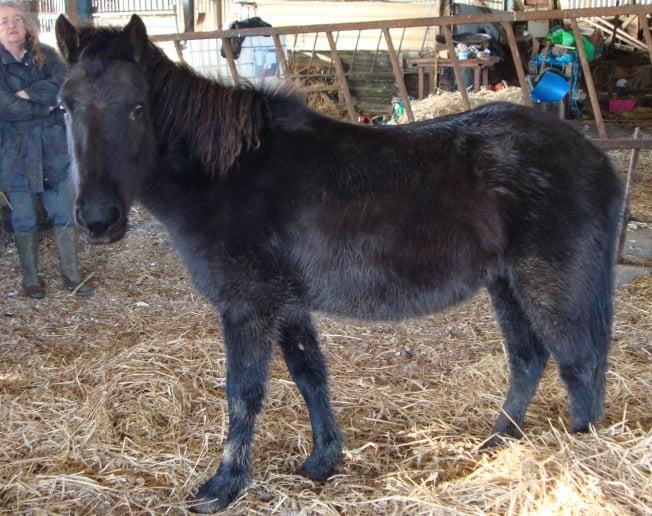
Online claims that the breed is typically black with white markings are overstated. Bay and chestnut are the most consistently reported common colours in mainstream breed references.1, 2
On size, many listings quote height in hands, but the more consistent published figures are in centimetres. Typical averages sit around 155 to 156 cm for stallions and about 151 cm for mares (roughly 15 hands). Individuals can be smaller or larger depending on type and breeding line.1, 2
Temperament and Personality
It is tempting to label any breed loyal or brave, but temperament is shaped as much by handling, training and selection within a line as by the breed name on a paper. What the Novokirghiz was bred for is more grounded: a practical horse for riding and work. In that role, steady-mindedness, tractability and stamina tend to be valued and selected for, especially in farm breeding programs where a horse has to be useful before it is pretty.1, 2
Uses and Roles
The Novokirghiz was bred to cover the same broad needs as the traditional Kyrgyz Horse, but with more size and power: riding, harness and farm work, plus production roles (horsemeat and mare's milk) that remain culturally and economically important in parts of Central Asia.1, 4 It has also been used in organised sport such as hippodrome racing, with published performance records reported in breed references.2
Training and Care
Care does not need to be exotic just because the breed comes from a distant landscape. Good horse care looks familiar everywhere: steady feed, routine health work and consistent handling.
- Feed: base the diet on forage (pasture and/or hay), then add hard feed only as workload, condition score and veterinary advice require.6
- Feet and legs: keep trimming and shoeing regular and matched to the terrain. These horses are often described as workmanlike and hardy, but they still need maintenance.
- Fitness: build endurance gradually. A horse bred for stamina still needs time to adapt tendons, ligaments and cardiovascular fitness.
- Health: routine dentistry, vaccination and parasite control as recommended by your local veterinarian.7, 9
Breeding Notes and Common Misconceptions
One repeated mistake is describing the Novokirghiz as a 19th-century Russian breed, or claiming it was created from an Orlov Trotter crossed with a Kazakh pony. Reliable breed references instead place its development in mid-20th-century Kyrgyzstan, based mainly on local Kyrgyz horses crossed with Don and Thoroughbred stock and related Don strains.1, 2
Another common mix-up is geography. Kyrgyzstan and Kazakhstan share steppe and mountain country, but the Novokirghiz is consistently described as a Kyrgyz breed developed in the former Kirghiz SSR.1, 2
Population and Conservation Status
Claims like "fewer than 2,000 worldwide" and "only a few hundred left in the wild" do not match the way this breed is described in major livestock-breed references. The Novokirghiz is a domestic breed, not a wild species, and some breed summaries report much larger population figures in its home region, in the tens of thousands.2
Conservation reporting can also be confusing. One widely repeated summary notes an FAO status (2007) of "not at risk", while later entries in FAO's DAD-IS database list the risk status as "unknown", which reflects reporting gaps rather than a confirmed collapse. The most defensible wording is that the breed's risk status is not consistently reported in recent international databases, rather than that it is endangered.1, 5
The Bottom Line
The Novokirghiz is a modern, purpose-bred Kyrgyz working horse: compact, hardy and built for riding, harness and farm work in tough country, with production roles alongside. If you have run into it in a pedigree or a listing, the practical takeaways are that it is a domestic breed from Kyrgyzstan (not Kazakhstan or 19th-century Russia), that bay and chestnut are its usual colours, and that talk of it being wild or on the brink is not supported by the mainstream references.1, 2
References
- Novokirghiz (New Kirghiz), breed summary
- Oklahoma State University, Breeds of Livestock: New Kirgiz Horses
- Don horse, background on the Don type referenced in New Kirghiz descriptions
- Kyrgyz Horse, traditional local breed and its relationship to the Novokirghiz
- FAO Domestic Animal Diversity Information System (DAD-IS)
- Merck Veterinary Manual, Overview of nutrition in horses
- Merck Veterinary Manual, Routine health care in horses
- Australian Veterinary Association, Horse welfare
- RSPCA Australia, Horse care information

Dog lover and writer at My Pets Australia, sharing practical breed guides and care advice for Australian pet owners.