Nova Scotia Duck Tolling Retriever
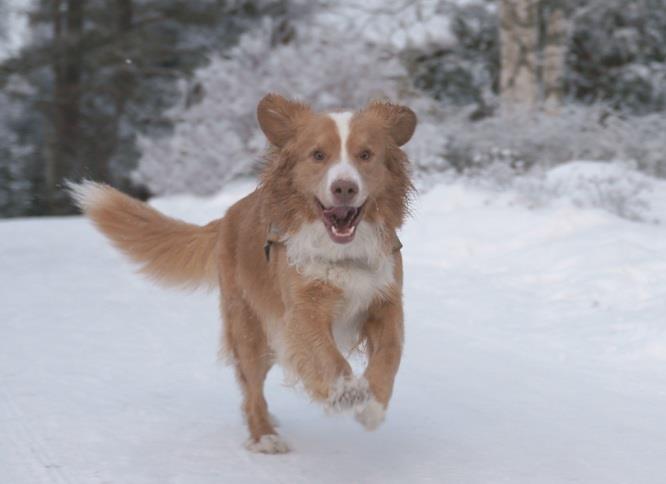
The Nova Scotia Duck Tolling Retriever, or "Toller", is the smallest of the retrievers, a compact red dog bred to work cold water and shorelines. It is clever, athletic, and intensely switched on when there is a job to do, which is exactly why active families, gundog owners and dog sport people keep coming back to the breed. It learns fast, it retrieves with real drive, and it notices everything. It is also a serious commitment. Give it a thin, low-activity day and it will invent its own work, usually something fast, loud and inconvenient.
History and Origin
The breed developed in Nova Scotia, Canada, in the early 1800s. Its speciality is "tolling", energetic movement along the shoreline that draws the attention of waterfowl, followed by steady retrieving once birds are down.3, 4
The Canadian Kennel Club recognised the breed in 1945. It later joined the American Kennel Club as a fully recognised Sporting breed on 1 July 2003.4, 7
Appearance and Physical Characteristics
Tollers are the smallest retrievers, but nothing about them reads as delicate. They are compact and athletic, built to work in cold, wet conditions, with a water-repellent double coat and a dense undercoat, plus enough feathering to shed water without turning into a mop.1, 2, 4
Males stand about 48 to 51 cm at the withers and females about 45 to 48 cm. Adult males typically weigh 20 to 23 kg and females 17 to 19.5 kg.1, 2 Colour sits in the red-to-orange range. White markings are common on the tail tip, feet, chest and blaze, but they are not mandatory under the standard, and a quality dog is not meant to be penalised for lacking white.1
Temperament and Personality
A well-bred, well-raised Toller is alert and responsive, quick to read patterns, and keen to move. Many are affectionate with their people, but this is not a set-and-forget companion. When their days are thin on activity, they tend to invent their own tasks, and those tasks are usually noisy, fast and inconvenient.2, 4
They do best in homes that treat training as a normal part of life: short sessions, clear rules, and plenty of reinforcement for calm behaviour as well as speed and enthusiasm. One thing worth planning for is the "toller scream". Some Tollers are notably vocal when excited, especially in anticipation, throwing a toy, arriving at training, watching birds. It is not universal, but it is common enough to factor in if you live close to neighbours or want a quieter household.
Is a Nova Scotia Duck Tolling Retriever Right for You?
For a low-activity household, honestly, no. This is a smart working gundog with a big engine, and in a home that cannot use that engine the energy spills sideways into nuisance behaviour. In the right home, one that enjoys training, daily activity and a dog that notices everything, they are bright, capable and deeply engaging company.2, 4
They also live a long time, often around 10 to 14 years, though individuals vary and lines and health screening matter. Take that as the length of the commitment before you take one on.
Training and Exercise
The reliable formula is daily physical exertion paired with mental work: retrieving drills, scent games, obedience, agility foundations, or structured play with rules. The goal is not to exhaust the dog into silence, it is to give the brain something steady to hold onto.2, 4
Positive reinforcement suits the breed well, especially when sessions are short and frequent. Consistency matters, because Tollers are quick to notice what works, including what works on you. Useful day-to-day outlets include:
- Retrieving games with a clear start and stop cue, so arousal does not just climb
- Loose-lead walking practice plus bursts of jogging or off-lead running where legal and safe
- Scent work, from food scatters to simple hides and tracking games
- Trick training and obedience, done in short blocks
The breed is at home wherever there is something to do. Many Tollers thrive in obedience, agility, retrieving activities and field work. The original purpose still shows up as intense play-drive, strong interest in birds, and a willingness to hit the water even when it is unpleasantly cold.4, 8
Health and Lifespan
No breed is problem free, but the Toller has a handful of conditions that responsible breeders actively screen and record. Health testing does not guarantee a healthy pup, but it meaningfully shifts the odds. The areas to ask about are:
- Hips (hip dysplasia): breeding dogs should have hip evaluations, commonly via recognised schemes such as OFA or PennHIP.5
- Eyes: regular eye examinations are recommended for breeding stock, given inherited eye disease risk.5
- Thyroid: thyroid testing is commonly recommended in breeding programs.5
- Addison's disease (hypoadrenocorticism): this can occur in any breed, but Tollers are listed among breeds overrepresented in diagnosis. Signs can be vague at first, and diagnosis relies on appropriate veterinary testing, often an ACTH stimulation test.6
Book a vet check sooner rather than later if you see repeated vomiting or diarrhoea, especially with lethargy or weakness; episodes that come and go, then return under stress such as travel, boarding, heat or intense exercise; unexplained weight loss or persistent poor appetite; or wobbliness, collapse, or unusual slowing down in an otherwise active dog. These signs can have many causes, but they deserve prompt assessment rather than watchful waiting, particularly in a breed with known endocrine risk.6
Grooming and Care
The coat is designed to cope with water and weather, which means it also sheds, often with seasonal surges. Weekly brushing is a sensible baseline, with more frequent sessions during coat blow to prevent matting in the undercoat and to keep hair off the furniture.
Bathing is usually occasional rather than constant. Keeping nails short, ears clean and dry (especially after swimming), and teeth maintained will do more for comfort than chasing a perpetually show-fresh coat.
Choosing a Breeder
With Tollers, temperament and health history matter as much as looks. A good breeder can explain why they chose a pairing, what health screening has been done, and what they see in the puppies as individuals. Questions worth asking:
- What hip, eye and thyroid testing has been done on both parents, and can you show the results?5
- Are there known Addison's cases in the pedigree, and how do you track long-term health outcomes?6
- How are puppies raised in the first eight weeks, in terms of noise exposure, handling, surfaces and early training?
- Which puppy suits a quieter home, and which one needs a job every day?
The Bottom Line
A Nova Scotia Duck Tolling Retriever is a small retriever with a big working engine. In the right home it is bright, capable and engaging. In a low-activity one its energy turns into nuisance behaviour. Choose carefully, prioritise health screening, and plan for the long run, because the best Tollers are shaped as much by daily routine and thoughtful training as by pedigree.
References
- The Kennel Club (UK), Retriever (Nova Scotia Duck Tolling) breed standard
- Canadian Kennel Club, Retriever (Nova Scotia Duck Tolling): height/weight, coat and activity notes
- Nova Scotia Duck Tolling Retriever Club (USA), Breed standard (overview and purpose)
- American Kennel Club, Press release: Addition of the Nova Scotia Duck Tolling Retriever (history and AKC recognition date)
- Nova Scotia Duck Tolling Retriever Club of Canada, Health screening guidance (hips, elbows, eyes, thyroid)
- Merck Veterinary Manual, Addison disease (hypoadrenocorticism) in dogs (overview, diagnosis, treatment; breed overrepresentation)
- Nova Scotia Duck Tolling Retriever Club of Canada, About (CKC recognition in 1945)
- NSDTRC (USA), Club history (AKC Miscellaneous 2001; Sporting Group acceptance 2003)

Dog lover and writer at My Pets Australia, sharing practical breed guides and care advice for Australian pet owners.