Murgese Horse
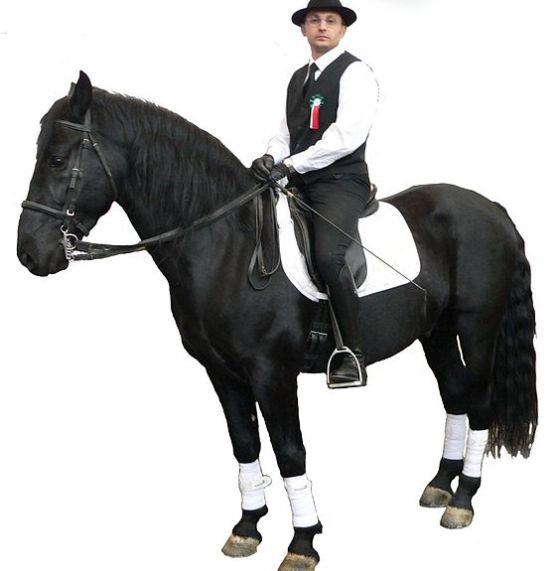
The Murgese is a black, powerfully built Italian riding horse from the Murge plateau of Puglia in Southern Italy. It is known for compact strength, notably hard dark hooves, and a calm, practical nature that suits real riding rather than the show ring. Most people find it online after spotting one and wondering what it is and whether it would suit their goals. It can be a steady, durable partner. It is also a rare breed with a limited global population, so buying one is not a casual decision.
History and Origin
The breed takes its name from Le Murge, a limestone plateau in Southern Italy that sits largely within today's Puglia. It is especially associated with the countryside around Martina Franca and neighbouring towns, where horses were traditionally kept in hard working conditions, on rough pasture, in heat and wind, over stony ground.1
Its development is usually linked to the period of Spanish rule in Southern Italy, with breeding influenced by imported horses of Barb and Arabian type crossed with local stock. Formal registration and systematic selection for the modern breed began in the early 20th century, including work at the state stud and registry at Foggia, then under royal administration.1, 3
Appearance and Physical Characteristics
A well made Murgese reads as strength organised into a clean outline: a solid, muscular body, a sturdy neck, a sloping shoulder, and limbs built to last. The head is typically straight or slightly convex in profile, with an alert, plain expression rather than an exaggerated show look. The hard, dark hooves are frequently mentioned as a hallmark of the breed.1, 4
Coat colour is one of the easiest tells. The typical Murgese is black, often described as raven black, though some registries and breeders also describe a small proportion of dark roan or iron grey coats. Claims of a distinctive white coat are incorrect, since white is not the breed's defining colour.1, 4
Most adults sit in a mid to upper riding horse height range, with mares commonly smaller than stallions. Breed overviews cluster around 150 to 162 cm for mares and 155 to 168 cm for stallions, roughly 14.3 to 16.2 hands. Weight varies with sex, age, work and condition, and most descriptions place the breed in the solid riding horse bracket rather than a true heavy draught type.1, 3, 4
Temperament and Personality
Across reputable breed descriptions, the Murgese comes across as manageable and willing, with enough sensitivity to be rideable and trainable but not typically hot headed. Individual temperament still depends on handling, breeding choices and early education, especially in a breed that has historically been kept in extensive, herd based systems.1, 3
Two common overstatements are worth avoiding:
- "Perfect for all riders." Any horse can be the wrong match if its schooling or energy level does not suit the rider.
- "Stubborn by nature." Some Murgesi are very steady and self contained, which can read as resistance when the training is unclear, rushed or inconsistent.
Is a Murgese Right for You?
For most Australian riders, honestly, this is not an easy horse to source. The breed is rare, concentrated in Italy, and any import means real cost, quarantine and paperwork. If you can find sound stock and you value durability over flash, the Murgese rewards you with a straightforward, hardy horse well suited to trekking, general riding and long seasons on uneven ground. It is a poor fit if you want a flashy show type, an instant availability, or a horse that trains itself. Buy from good stock, look for studbook documentation, and treat the training and management as seriously as you would for any riding horse.1, 2
Training and Exercise
Murgesi were shaped by practical work, and they usually respond well to calm, consistent handling that rewards the right answer and does not nag. Clear cues, steady repetition and fair boundaries get further than constant pressure.
Because the breed is valued for toughness and soundness, it is easy to assume it needs little management. In reality, good results still depend on basics: progressive loading and conditioning for fitness, joints and tendons, good farriery, and a diet that supports work without pushing the horse into excess condition. Today the Murgese is kept mainly as a riding horse, used for trekking and general riding and, depending on individual movement and training, a range of sport disciplines. That old farm and military utility still shows in its compact power and durability.1
Health and Lifespan
No breed comes with a guarantee of no health issues, and the Murgese is no exception. What you can fairly say is that it has a long standing reputation for hardiness in extensive conditions, with good feet and practical toughness frequently noted. Even so, any individual horse can develop lameness, metabolic issues, dental problems, skin disease or injury depending on management and workload.1
Day to day care rests on the same foundation as any riding horse:
- forage first feeding from pasture or hay, with concentrates only as needed for work and condition
- regular dental care, plus vaccination and worm control appropriate to your region
- farriery matched to hoof quality, terrain and workload
- progressive conditioning for fitness, joints and tendons
Breeding and Conservation
The main pressure on the Murgese is the simple arithmetic of rarity. The modern breed is managed through an Italian studbook system, with ANAMF serving as the breed association and registry body, so studbook documentation matters when you buy.2 Smaller populations make it harder to maintain genetic diversity and can concentrate particular lines if breeding choices narrow over time. FAO's Domestic Animal Diversity Information System, DAD-IS, has listed the breed as at risk or vulnerable in recent reporting, which reflects that conservation concern even though the horses themselves are not inherently fragile.1, 5
If you are considering breeding, think beyond a single foal. Pedigree depth, inbreeding management and how the horse fits the registry's direction all carry extra weight in a small breed.
A Few Things Worth Knowing
- The Murgese is not a white show horse. Its defining colour is black, sometimes raven black.4
- Hard, dark hooves are a recognised hallmark of the breed.1
- Its blend of substance and rideability traces to imported Barb and Arabian type horses crossed with local Southern Italian stock during Spanish rule.1, 3
- The registry maintains an online genealogy portal for studbook searches.6
The Bottom Line
The Murgese is a black, practical, historically working breed: compact power, hard feet, and a calm presence that makes sense on trail kilometres, uneven ground and long seasons. For riders who value durability and a straightforward horse, it can be a quietly impressive choice, provided you buy from good stock and keep the training and management sensible. In Australia the real hurdle is availability rather than the horse itself.1, 2
References
- Murgese (breed overview, history, characteristics, height ranges, conservation notes)
- A.N.A.M.F. (Associazione Nazionale Allevatori del Cavallo delle Murge e dell'Asino di Martina Franca), official association site
- Agraria.org: "The Murgese" (origins, registration history, morphology and height ranges)
- Masseria Capoiazzo: Murgese horse breed standard (coat description and typical morphology)
- FAO Domestic Animal Diversity Information System (DAD-IS)
- ANAMF database (studbook and genealogy search portal)
- Horses of the World: Murgese (general characteristics, height and use summary)
- The Equinest: Murgese (overview of traditional colours and general type)

Dog lover and writer at My Pets Australia, sharing practical breed guides and care advice for Australian pet owners.