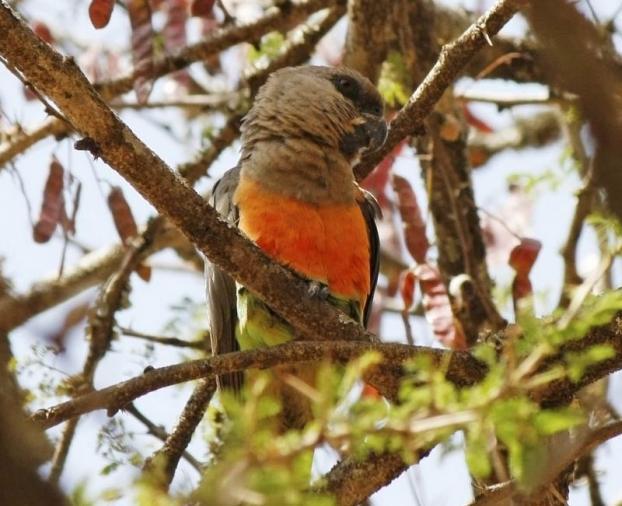
Meyers Parrot
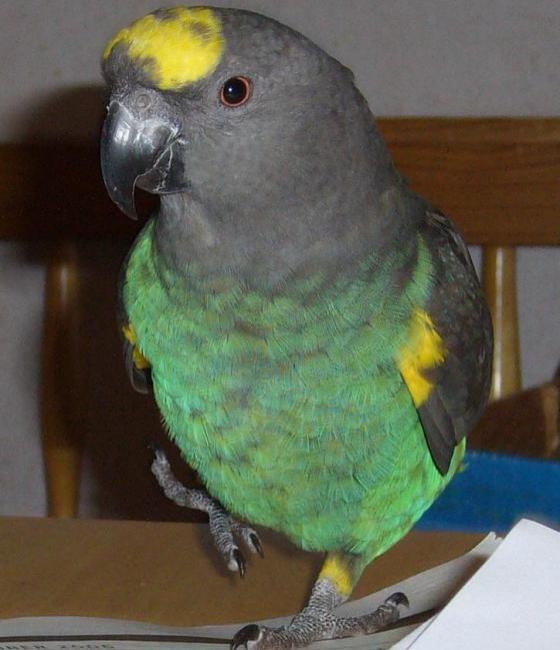
The Meyer's Parrot (Poicephalus meyeri) is a small African parrot with a smoky grey-brown body, quick flashes of yellow and blue-green, and a steady, watchful manner. It has a reputation as one of the calmer companion parrots: often quieter than similarly sized birds, curious without being frantic, and happy to potter about investigating whatever is happening in the room. Talking ability is hit and miss, but that is rarely why people keep one. What you are signing up for is a long relationship, since a well cared for Meyer's often lives 20 to 25 years. The care is manageable, but only if you get the basics right from the start.1, 2
Quick Facts
- Scientific name: Poicephalus meyeri1
- Adult size: about 21 to 24 cm long1
- Adult weight: commonly around 100 to 135 g, varying by individual and subspecies1
- Typical lifespan in care: often 20 to 25 years with good husbandry, sometimes longer1
- Noise level: generally quieter than many similarly sized parrots, but still capable of sharp calls1
- Talking ability: variable, with some learning a small set of words and many staying limited talkers1
- Wild range: a broad belt of sub-Saharan Africa, especially woodland habitats2
History and Origin
First, the correction, because it comes up constantly: the Meyer's Parrot is not from Madagascar and it is not South American. It is an African species, ranging widely through parts of central, eastern and southern Africa, with local highs and lows in abundance depending on habitat and pressure from people.2
In the wild it is most at home in woodland country: dry savanna woodlands, riparian or gallery woodland along waterways, and other tree-rich landscapes that offer both food and hollows for roosting and nesting.2
Appearance and Physical Characteristics
A Meyer's is compact and stocky, built for quick, direct flight and agile climbing. The overall impression is smoky brown-grey, lifted by small flashes of colour: a yellow patch on the crown in many birds, yellow on the bend of the wing and on the thighs, and a blue-green wash over the lower belly and rump.1
Adults typically sit around 21 cm in length, with weights commonly in the 100 to 135 g range, and both individuals and subspecies vary.1
Temperament and Personality
Meyer's Parrots come across as quietly busy birds: alert, observant, and quick to investigate any change in the room. Many will bond strongly to one person if their social contact is narrow, so a wider, gentle routine with several calm handlers and predictable interactions helps prevent over-attachment and the behaviours that come with it.1
They are frequently described as comparatively quiet for a parrot, but quiet still includes contact calls, morning and afternoon bursts, and the occasional piercing alarm note if something startles them.1
Is a Meyer's Parrot Right for You?
If you want a smaller, calmer parrot and you can commit to two decades or more of daily care, a Meyer's is a genuinely good match. The catch in Australia is sourcing, not suitability. Australia has strict rules around live animal imports, and for live birds you generally need to satisfy both environmental requirements, including whether a species sits on the Live Import List, and biosecurity import conditions. Many species are not eligible for import at all unless permitted under the relevant frameworks.5, 6
The practical path for almost everyone is to work with reputable Australian breeders and rescues rather than attempting any overseas sourcing.5, 7 Once the bird is home, the commitment is real: daily out-of-cage time, a proper diet, and a household rhythm the bird can rely on for the length of its life.
Care and Housing
A Meyer's needs space to move, climb and flap properly, plus daily out-of-cage time if it is kept indoors. They do best with a steady routine and an environment that gives them safe work to do: shredding, foraging, climbing, and short training sessions that keep the mind occupied.1
- Perches: mixed natural diameters for foot health.
- Foraging: part of the daily ration hidden in paper parcels, cups, or foraging toys.
- Chew and shred toys: rotated often to prevent boredom.
- Light and sleep: consistent, dark, quiet sleep time helps reduce irritability and screaming.
Diet and Nutrition
Wild Meyer's Parrots feed mainly on plant foods such as fruits, seeds and nuts, sometimes taking other items opportunistically, including insects or grain where it is available.2
For pet birds, aim for a diet that is steady, varied, and not dominated by fatty seed. Many avian veterinarians recommend a quality formulated pellet as the base, supported by daily vegetables and smaller amounts of fruit, with higher-fat seeds and nuts used more as training rewards than staples.3
- Daily: pellets plus a generous serve of vegetables such as dark leafy greens, capsicum, carrot, broccoli and pumpkin.
- Several times a week: fruit in smaller portions, for example berries, apple, pear and melon.
- Occasional: nuts and seeds as high-value treats, especially for training.
- Always: fresh water, changed daily.
Health and Lifespan
Most serious problems in companion parrots trace back to preventable pressure points: an all-seed diet, limited exercise, chronic stress, poor air quality, and a lack of routine veterinary checks. Obesity and related liver disease are recurring issues on seed-heavy diets, while behavioural problems, including feather damage, often follow boredom or inconsistent handling.3
Book regular check-ups with an avian veterinarian, and treat sudden changes as urgent: sitting fluffed, tail bobbing, reduced appetite, new wheezing, or a drop in activity. Birds hide illness until they can no longer manage it.4 With good husbandry, a Meyer's commonly reaches 20 to 25 years and sometimes beyond.1
A Few Things Worth Knowing
- Breeding: in the wild, Meyer's Parrots roost and nest in cavities, including tree hollows. Captive breeding relies on compatible pairs, privacy, and an appropriate nest box, with careful attention to nutrition and veterinary oversight before and during breeding.2
- Single companion birds: if you keep one bird, the priority is avoiding accidental nesting triggers, such as dark cave-like spaces, access to boxes, and high-calorie diets combined with long daylight hours.3
- Conservation: the species is listed as Least Concern globally and is not considered globally threatened, though local declines can occur where woodland is cleared, birds are persecuted as crop pests, or trapping pressure rises.2
- Trade: it is listed under CITES Appendix II, which regulates international trade to help prevent unsustainable exploitation.2
The Bottom Line
A Meyer's Parrot is small, resilient, and often pleasantly understated, more woodland sentinel than clown. Given enough space, a balanced diet, and daily enrichment, it can be a steady companion for decades. The essentials are simple but non-negotiable: good food, clean air, room to move, and a household rhythm the bird can rely on.1, 3, 4
References
- World Parrot Trust, Meyer's Parrot (Species information)
- World Parrot Trust, Meyer's Parrot Research (Range, habitat, threats; IUCN/CITES notes)
- Veterinary Partner (VIN), Feeding Pet Birds (General dietary guidance for companion birds)
- RSPCA, Pet bird welfare and care advice
- DCCEEW (Australian Government), Live Import List (Wildlife trade)
- DCCEEW (Australian Government), Do I need a permit? (Wildlife trade permits)
- Department of Agriculture, Fisheries and Forestry (Australian Government), Importing your pet bird
- Department of Agriculture, Fisheries and Forestry (Australian Government), Importing live animals and reproductive material
- Australian Border Force, Importing animals (overview and agency responsibilities)

Dog lover and writer at My Pets Australia, sharing practical breed guides and care advice for Australian pet owners.