Mangalarga Marchador
The Mangalarga Marchador is a medium-sized Brazilian riding horse best known for one thing: how it feels to sit on. Instead of a bouncing trot it offers a natural, four-beat "marcha" gait that keeps the back steady and the rhythm even, which is why riders reach for it when they want to cover long hours without arriving battered. It is sure-footed, durable and willing to work when handled with consistency. The gait is genuinely comfortable, and the breed's history is genuinely interesting, but both are often muddled online. Here is a cleaner picture of where it comes from, how it moves, and what it takes to keep one well.
History and Origin
The breed developed in Brazil, built on Portuguese and Iberian horses crossed with local stock. The most notable influence is the Alter Real, a Lusitano strain from Portugal's royal stud.1, 3 Early breeders wanted an animal that could carry a rider comfortably through long days and stay sound over rough farm country.
One point is often stated wrongly. The breed's main association, the Associação Brasileira dos Criadores do Cavalo Mangalarga Marchador (ABCCMM), was founded on 16 July 1949 and is the body accredited by Brazil's agriculture ministry to manage official genealogical registration for the breed.2 Many articles incorrectly cite "government recognition in 1940".
Appearance and Physical Characteristics
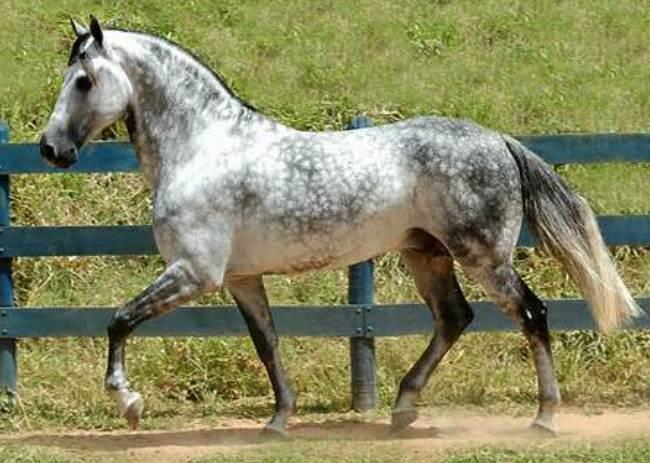
This is a practical saddle horse, not a fine, tiny type and not a heavy draught type. Expect a balanced outline: a well-set neck, defined withers, a deep girth and a sloping croup, with muscling that builds through the hindquarters and topline when the horse is worked correctly.1 The chest is deep, the hooves are durable, and the coat is generally short and sleek, varying with season and management.1
Height is commonly quoted in metres in Brazilian sources rather than in hands. Registry figures place stallions higher than mares, with many horses sitting between about 1.40 m and 1.57 m at the withers, roughly 14 to 15.2 hands.1 That makes the common claim of "1.5 to 1.6 m" too narrow, and too tall for many mares. Many solid colours are accepted, while some patterns may not be accepted for registration.1
Temperament and Personality
Most Marchadors are bred to be rideable: steady enough for long work, alert without being hot, and responsive when the rider stays clear and consistent.1 Temperament still varies as it does in any breed, and early handling matters. These horses tend to reward quiet aids, a stable seat, and fair pressure-and-release rather than force.
The Two Marcha Gaits
The breed is defined less by spectacle than by a particular quietness of motion, and that comes down to the marcha. There are two recognised versions, and "marcha" is not a single gait: individuals may prefer one style, and training influences how clear and clean it becomes.
- Marcha batida: a four-beat gait with more diagonal timing, loosely compared to a fox-trot style of footfall.1
- Marcha picada: a four-beat gait with more lateral timing, closer in feel to a stepping pace or singlefoot.1
Both are meant to be efficient, ground-covering and comfortable. The breed does not trot in the usual sense.1
Is a Mangalarga Marchador Right for You?
A Marchador can suit a newer rider, but the best match is someone who values balance and rhythm over speed. These horses reward quiet aids and enough time to let the marcha develop without tension. If you want raw pace or a jumping specialist, look elsewhere.
In practice they are used for general riding, trail and distance work, and disciplines where smoothness and stamina help. Internationally you will also see them in dressage foundations and working equitation style riding, depending on what is available locally. They are not primarily a show jumping breed the way warmbloods are. Some individuals jump well, but the breed's reputation rests on comfort, sure-footedness and durability.1 Owning any horse is also a serious commitment of time, space and money, so be honest about your setup before you buy.
Training and Exercise
The marcha is natural, but tension, poor balance or rushing can blur it. Training works best when it stays simple and physical: correct straightness, strength through the topline, and calm repetition.
- Let the rhythm arrive: avoid pushing for speed early, because clarity usually improves once the horse is relaxed and strong enough to carry itself.
- Short, frequent conditioning: the marcha is easier to hold when the horse is fit through the back and hindquarters, not merely tired.
- Watch the feet, not the headline gait: farriery and balance can make or break a comfortable, regular four-beat rhythm.
Health and Lifespan
Day-to-day care is standard horse care: forage-first feeding, clean water, safe fencing, hoof maintenance, dental checks, and a workload that matches fitness. Owners usually get caught out not by breed-specific disease but by ordinary horse problems, parasites, preventable infections and slow-developing lameness, when routine management slips.
Vaccination programs vary by region and lifestyle, so follow your veterinarian's advice. In Australia many programs commonly include tetanus and strangles, and in Hendra-risk areas Hendra vaccination is often strongly recommended.6, 7 Queensland's guidance is clear that vaccinating horses is the most effective way to manage Hendra risk and reduce the chance of transmission to people and other animals.7
Worm control works best when it is planned rather than done by the calendar. Australia's regulator notes that resistance can develop to any anthelmintic, and labels commonly advise seeking local veterinary guidance and considering resistance testing before treatment.8 Accurate dosing matters too: dose to the horse's weight and avoid underdosing.8
Breeding and Registration
If you are buying a horse advertised as a Mangalarga Marchador, the registration paperwork should link back to the official studbook system managed through ABCCMM and its affiliated nuclei and associations in other countries. That role is not ceremonial. It is the framework that maintains breed identity, records lineage, and anchors the breed standard over time.2
The Bottom Line
The Mangalarga Marchador is a horse shaped by distance: long days, steady ground, and a rider who wants to finish still comfortable in the saddle. When the marcha is pure and the training stays patient, the ride is quiet and even, four beats on the ground with no bounce. If comfort, stamina and sure-footedness matter more to you than speed or spectacle, it is a genuinely rewarding breed.
References
- Mangalarga Marchador (breed overview, characteristics and gaits), Wikipedia
- ABCCMM, Quem somos (about the association; founded 16 July 1949; accredited for genealogical registration)
- Mangalarga (related Brazilian breed history and Alter Real influence), Wikipedia
- Marchador Breed, The M Foundation (history and Alter Real "Sublime" account)
- Mangalarga Marchador (German summary of Alter Real origins), Wikipedia (DE)
- How often and for what do I need to vaccinate my horse?, Townsville Vet Clinic (vaccination schedule overview)
- Hendra virus vaccine for horses, Business Queensland
- Anthelmintics for horses, specific requirements (labels, resistance warning, dosing to weight), APVMA

Dog lover and writer at My Pets Australia, sharing practical breed guides and care advice for Australian pet owners.