Keeping Amazon Fish in a "Natural" Aquarium
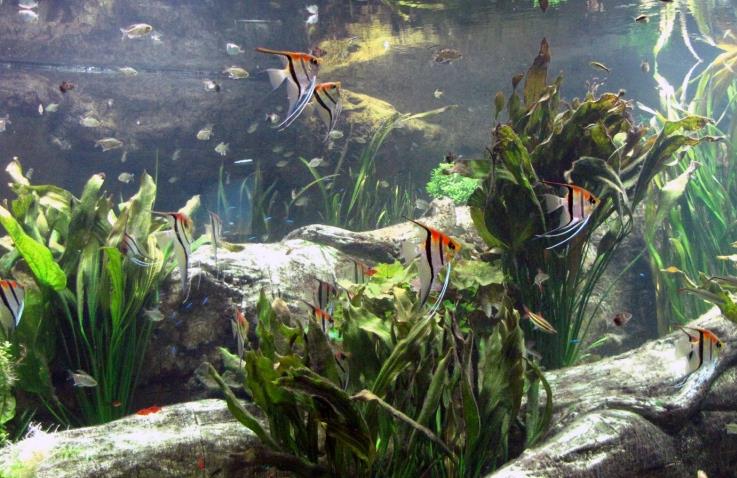
A natural Amazon-style aquarium is one of the most rewarding freshwater setups you can build: warm, tea-tinted water, tangled driftwood, dense planting, and showpiece fish like angelfish and discus moving through the shade. The look is genuinely striking, and the fish that suit it are some of the most characterful in the hobby. It is also a fussier setup than a general community tank, because these fish want warm, clean, stable water and enough space to spread out. Get the basics right and the tank settles into a quiet rhythm. Get them wrong and the trouble arrives slowly, with stressed fish, algae, and water that never quite stabilises.
Tank size and the Amazon look
Angelfish and discus are tall-bodied fish, and they look their best when they can turn and rise without folding their fins against the glass. Some care guides list smaller minimums for a single angelfish, but a mixed Amazon showcase with large cichlids needs room for adult size, hierarchy, and plant mass.
- Angelfish: a small group generally does best from around 55 US gallons (about 208 L) and up, with good height as well as volume.1, 2
- Discus: they are commonly kept in groups and prefer very stable, warm water. Many guides put a group tank at roughly 55 US gallons (about 208 L) or larger, and bigger is easier to keep stable.3
If you are planning adult angelfish and adult discus together, think in the range of 350 to 500+ litres as a practical starting point. That is not because the river demands it, but because the fish do.
The Amazon feel comes from structure more than decoration: submerged roots, driftwood, scattered leaf litter, and shaded water. In the wet season, fish move into flooded margins where tangled vegetation and wood create refuge and breeding areas. Your tank can echo that with:
- Driftwood and branchy root pieces to break up sightlines
- Dense planting at the back and sides, with open water through the middle
- Soft, subdued lighting and some surface cover from floating plants
Substrate, wood and rocks
Skip the creek gravel. Collecting gravel, sand, rocks, or wood from local waterways can introduce pollutants, parasites, and unwanted hitchhikers, and it risks bringing in materials that leach minerals or metals. For a tank you want to keep stable for years, use aquarium-safe substrate from a reputable supplier.
A simple, reliable approach for an Amazon-style planted tank is:
- Base: a purpose-made planted aquarium substrate, or a thin layer of mineralised topsoil capped properly if you are experienced
- Cap: fine sand or fine gravel to keep the water clear and protect plant roots
If you like the riverbank look, choose a fine, pale sand with a few darker patches, then let leaf litter and wood do the rest.
Use driftwood sold for aquariums or from a trusted supplier. Wood should be scrubbed, rinsed, and soaked. It may release tannins at first, which can tint the water tea-coloured. That suits an Amazon aesthetic and is harmless for most Amazonian fish. Rocks should be inert (not fizzing in vinegar). Avoid unknown stone that may harden the water over time.
Heating, filtration, lighting and oxygen
Warmth and gentle flow are the two things this tank type lives and dies by. Discus and angelfish prefer warm water, and discus in particular are commonly kept at about 28 to 31 °C (82 to 88 °F).3 Angelfish tolerate a broad tropical range, often cited around 24 to 30 °C, which overlaps well with a warm Amazon tank when the fish are healthy and the water is clean.2
Aim for:
- Stable temperature: keep the tank away from windows and direct sun, since temperature swings and algae follow
- Strong biological filtration with gentle flow: canister filters or large hang-on-back filters work well when the outlet is directed to avoid blasting the fish
- Redundancy if you can manage it: two appropriately sized heaters can reduce risk if one fails
Plants need adequate light, but Amazon fish often look and behave better under softer, broken light. Use a quality LED made for planted tanks and keep the photoperiod steady. Start at about 8 hours a day, then adjust based on plant growth and algae. If algae appears early, reduce intensity or duration before you reach for chemical fixes.
Air stones do not inject oxygen into the water in any simple way. Their main value is the surface agitation they create, which improves gas exchange. A good filter outlet that gently ripples the surface often provides enough oxygenation on its own. Live plants also produce oxygen during the light period, though they consume oxygen at night like any living organism. In warm water, where oxygen is naturally lower, steady surface movement is your quiet insurance.
Water quality and cycling
For Amazonian species, stability matters as much as hitting a perfect number. Australian tap water is usually safe for people, but the disinfectants used for public health can harm fish, so always treat new water with a proper aquarium dechlorinator.
- Chlorine can dissipate over time, but the rate varies and it is not a dependable method for aquarium use.
- Chloramine, used by some water providers, does not rapidly dissipate by standing and must be neutralised with appropriate conditioners.4
Before buying fish, test your water with a liquid kit and learn the rhythm of your tank. Practical target ranges are:
- Ammonia: 0
- Nitrite: 0
- Nitrate: keep low, especially for discus and cardinal tetras, where lower is better
- Temperature: commonly 28 to 30 °C in a discus-centred tank3
- pH: many Amazon fish do well in slightly acidic to neutral conditions. Do not chase numbers with harsh chemicals, prioritise stability
A new tank also needs time for nitrifying bacteria to establish in the filter media and substrate. This cycle is what converts toxic ammonia into nitrite, then into nitrate. Until it is established, fish are living in their own waste. Fishless cycling with a measured ammonia source is widely used because it avoids exposing fish to toxic spikes. The cycle is considered complete when the tank can process an added ammonia dose down to zero ammonia and zero nitrite within about 24 hours, leaving nitrate as the end product.5
Plant choices that suit the look and the fish
An Amazon-inspired tank can be coherent without being a strict biotope. Choose plants that tolerate warm water and lower flow, and that offer vertical cover for angelfish.
- Tall background plants for shelter and to soften corners
- Mid-ground clumps to create rooms and hiding spaces
- Floating plants for shade, used sparingly so you do not block gas exchange
Quarantine or rinse plants from any source. Wild-collected plants can carry snails, parasites, or pathogens.
Stocking the tank
Resist the urge to build the full cast list at once. Add fish slowly so the filter bacteria can grow with the bioload.
Angelfish (Pterophyllum scalare)
Angelfish can be kept as a bonded pair or a small group, but they can become territorial as they mature. In groups, space and visual barriers reduce bullying.1, 2
Discus (Symphysodon spp.)
Discus are sensitive to poor water quality and are usually kept in groups, in warm water, and in very clean conditions. If you are new to fishkeeping, consider running the tank successfully with hardier fish first, or keep discus in a species-focused setup.3
Cardinal tetras (Paracheirodon axelrodi)
Cardinals are schooling fish and look best in a proper group. They prefer soft, slightly acidic water and steady conditions. They are also more vulnerable to poor water quality than many beginner tetras, so add them only once the tank is well established.6, 7
Bristlenose catfish (Ancistrus spp.)
Bristlenose are useful algae grazers, but they are not a cure for a tank that is getting too much light or too many nutrients. They also need a real diet, not just algae, and benefit from driftwood and hiding places.8
A note on odd numbers and sexing fish
Aggression is more about space, maturity, and territory than whether you have an odd or even number of fish. Sexing angelfish and discus at the shop is often uncertain unless you are buying proven adults, and even then it is not foolproof. Plan your layout so weaker fish can disappear from view when needed.
Setting up and keeping the tank calm
A clean setup sequence saves you a lot of trouble later:
- Place the tank away from direct sun and draughts.
- Add substrate, planted base first if you are using one, then cap with sand or fine gravel.
- Position wood and rock so it is stable and creates broken sightlines.
- Fill slowly onto a plate or bag to avoid stirring the substrate.
- Install heater and filter, and aim the outlet for gentle surface movement.
- Plant heavily from the start, which helps compete with algae.
- Dechlorinate as you fill.
- Cycle the tank fishlessly and test regularly until ammonia and nitrite are consistently zero after dosing.5
- Add fish gradually, starting with hardier species, and wait between additions.
Once it is running, small regular maintenance beats big heroic clean-ups.
- Water changes: 25 to 50% weekly is common in discus-centred systems, especially as stocking and feeding increase.3
- Vacuum gently: lift waste from open areas without uprooting plants.
- Filter care: rinse media in old tank water, not under the tap, to protect beneficial bacteria.
- Test routinely: temperature, ammonia, nitrite, and nitrate, especially after adding fish or changing feeding.
If algae is thriving, treat it as a sign of too much light, too many nutrients, or not enough plant growth. Cleaner fish can help tidy surfaces, but they will not correct the underlying conditions.
References
- EasyClean Aquatics, Angelfish (Pterophyllum scalare): adult size and recommended aquarium size
- Tropical Fish Hobbyist (TFH), Pterophyllum scalare profile (size, temperature range, minimum tank guidance)
- Fishkeeping World, Discus fish care guide (temperature range and general requirements)
- United States EPA (archived page), Chloramine: does not rapidly dissipate on standing; aquarium water must be treated
- DrTim's Aquatics, Fishless cycling method and cycle-complete criteria (ammonia to nitrate with zero nitrite)
- Aquatic Community, Cardinal tetra (Paracheirodon axelrodi): temperature and pH range, sensitivity
- Aquarium Tips, Cardinal tetra care notes (clean, stable water; best added to established tanks)
- Fishkeeping World, Bristlenose pleco care (tank conditions, driftwood, filtration)

Dog lover and writer at My Pets Australia, sharing practical breed guides and care advice for Australian pet owners.