Hairless Rats
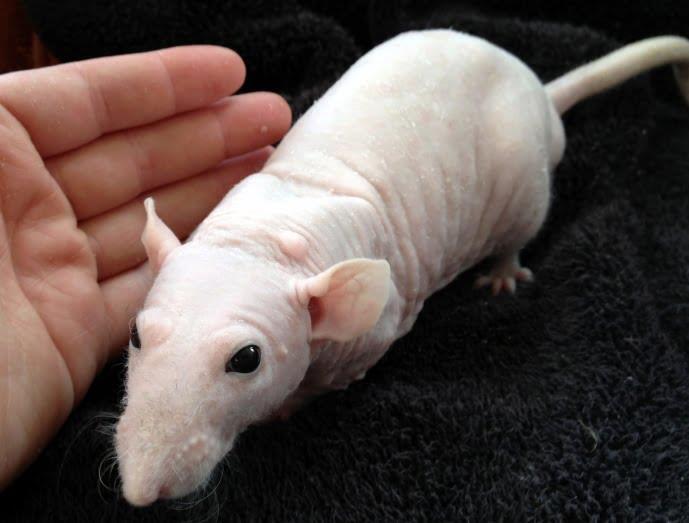
Hairless rats are pet rats with little to no coat, kept by people who want something a bit different from the usual fancy rat. Under the bare skin they are the same animal: bright, busy, and social, with the curiosity and quick learning that make rats such good company. The trade-off is practical rather than dramatic. Without fur they lose heat faster and their skin needs a closer eye, so steady indoor conditions and clean housing matter more than they do for a coated rat.1, 2 Get the environment right and they thrive on routine, gentle handling, and the company of other rats.
Size: Varies by strain and breeding line (pet rats commonly fall in the 300 to 650 g range as adults; hairless types may be lighter-built).6
Colour: Skin colour varies (often pink, mottled, or darker pigmented depending on genetics).7
Coat: Hairless or near-hairless; some "nude" lines can have fine down or patchy regrowth over time.7
Eyes: Varies (including dark or red/pink in albino lines).7
Ears: Varies by type; "dumbo" refers to low-set, larger ears (this is a look, not a separate species).8
Temperament: Rats are generally social, intelligent, and active, with strong individual differences.1
Common health watch-outs: Temperature sensitivity and skin irritation are the usual husbandry pressure points; respiratory irritation can be worsened by poor ventilation and ammonia build-up from urine.1, 2
What a Hairless Rat Actually Is
In pet circles, "hairless rat" is used broadly for rats with very little coat. Some are born largely hairless, some have thin, patchy hair, and some grow and lose hair in cycles depending on the genetic line behind them.7
One well-known research model is the "nude" rat, where hairlessness is tied to a mutation affecting the thymus and T-cell development, which leaves the animal immunodeficient. Those rats are bred for laboratory use, not as pets, but the term "nude" sometimes spills into pet descriptions and causes confusion.7, 9
History and Origin
Domestic pet rats, often called fancy rats, come from the same species as the common brown or Norway rat, selectively bred for temperament and colour over many generations.5
Hairless varieties appear through specific mutations that breeders maintain. Separately, hairless "nude" rats became important in biomedical research because immunodeficiency makes certain kinds of studies possible.7 The older claim that hairless rats have been kept as pets for centuries is hard to substantiate cleanly. What is well documented is that purposeful breeding of specialised rat strains, including hairless research models, is a modern, recorded practice.7
Genetics: What Is Accurate, and What Gets Repeated Wrong
Hairlessness in rats is not one simple story. Different hairless phenotypes can come from different genetic changes, and the "nude" phenotype commonly referenced in research is associated with mutations in FOXN1, not the EDAR gene.7, 9
Because breeders may use the same casual labels for different lines, it is worth asking what you are actually getting: a pet-bred hairless line, or an animal with special needs, including potential immune issues, that you may not be equipped to manage.
Everyday Differences From a Coated Rat
The bare skin changes three things you will notice day to day.
Temperature and comfort
Without fur, heat loss is faster. That does not mean constant cuddles for warmth, but it does mean steadier indoor conditions, protected sleeping areas, and careful placement of the enclosure away from drafts and direct sun.1, 2, 6 A widely recommended temperature band for rats is roughly 18 to 26 °C, with moderate humidity of about 30 to 70%.6
Skin and grooming
Fur normally buffers skin from friction, minor knocks, and drying air. Hairless rats can be more prone to dry patches, small scratches, and irritation, especially if bedding is dusty, the cage is not cleaned often enough, or the air is very dry.1, 6
Allergies
Hairless does not mean hypoallergenic. Most rat allergens are carried in urine, saliva, and dander or skin particles, not just the fur you can see.4
Is a Hairless Rat Right for You?
If you already like rats and can hold a stable indoor climate, a hairless rat is a reasonable choice. They are not a low-effort pet. You take on steadier temperature management, kinder bedding choices, and a habit of checking the skin the way you would check a short-coated dog's paws after a walk. They also cannot be kept alone, so you are committing to at least a compatible pair and the housing that goes with it. If your home swings hot and cold through the day, or you were hoping hairless meant allergy-free, a coated fancy rat is the easier animal to live with.
Housing and Environment
Rats do best indoors in a well-ventilated enclosure that is easy to clean, with a solid base and deep bedding for digging and nesting. Good ventilation matters because ammonia from urine can build up quickly and irritate airways.1
For hairless rats, add a little more attention to microclimate:
- Nesting layers: provide soft nesting material and enclosed hides so they can choose a warmer pocket of air.1
- Draft control: avoid placing the cage near doors, windows, or direct air-conditioning flow.2, 6
- Clean, low-dust bedding: reduce respiratory and skin irritation risk by keeping the enclosure clean and choosing bedding that does not throw fine dust.1
Rats are not solitary animals. They typically do best in small, compatible groups, often same-sex pairs or groups, introduced thoughtfully to reduce stress and fighting risk.1, 3
Handling, Training and Enrichment
Hairless rats learn the same way as other pet rats, through calm repetition and rewards. Keep sessions brief, use gentle handling, and let the rat choose to approach your hands rather than being grabbed from above.
RSPCA guidance for rats emphasises regular mental and physical stimulation: climbing space, hiding spots, chewing opportunities, and time out of the enclosure in a safe area.1, 5
Health and Lifespan
Air quality is often the bigger long-term risk, even though the word "hairless" draws all the attention to skin. Three areas are worth watching closely.
Skin irritation and infection
Check the skin often under natural light. Look for:
- dry, flaky patches
- redness, scabs, or weeping sores
- scratches around the shoulders or hips, which are common friction points
Do not self-treat with human creams unless an exotics vet advises it. Many products are too strong, too perfumed, or unsafe if licked.
Heat and cold stress
Rats are sensitive to temperature extremes and have limited capacity to regulate body temperature, so the enclosure environment matters more than most new owners expect.6
Respiratory irritation
Poor ventilation and urine build-up increase ammonia, which can irritate the respiratory tract.1
On lifespan, pet rats typically live around 2 to 3 years, with some variation by genetics and care.5, 10
A Few Things Worth Knowing
Pet rat terminology is often informal. Two labels come up constantly:
- Dumbo: an ear type, with larger, lower-set ears. It is not a different species and is not inherently linked to health or lifespan.8
- Nude: sometimes used loosely for hairless pets, but in research it commonly refers to immunodeficient lines linked to FOXN1 mutations.7
The Bottom Line
A hairless rat is still, at heart, a rat: social, curious, and tuned to the small patterns of a home. The fur is the only missing layer, and in exchange you take on steadier temperature management, kinder bedding choices, and regular skin checks. Choose a reputable source, keep them in compatible company, and set the enclosure up like a calm, well-ventilated burrow with warm corners. Most of the rest follows.
References
- RSPCA Australia Knowledgebase: How should I care for my rats?
- RSPCA Surrey East: Caring for your rat (temperature guidance)
- RSPCA Australia Knowledgebase: What company do my pet rats need?
- Thermo Fisher Scientific (Allergen Encyclopedia): Rat allergens (urine, saliva, dander)
- RSPCA (UK): Rats as pets (lifespan and care overview)
- Merck Veterinary Manual: Special considerations for rats (temperature and humidity)
- Taconic Biosciences: NIH nude rat (FOXN1-related "nude" model background and phenotype)
- PetMD: How long do rats live? (overview of lifespan)
- Janvier Labs: Fischer nude immunodeficient rat (Foxn1 mutation and phenotype)
- RSPCA Kids Education (Australia): Rats (lifespan and general facts)

Dog lover and writer at My Pets Australia, sharing practical breed guides and care advice for Australian pet owners.