French Trotter - Norman Trotter
The French Trotter (Trotteur Français) is a French harness-racing breed shaped in Normandy through the 1800s, and its whole reason for existing is one skill: holding a fast, balanced trot under pressure without breaking into a canter. It is an efficient, athletic, hard-working horse bred for the track rather than the show ring. People also search for it under the loose label "Norman Trotter", which is where things get muddy, because that phrase is not a modern, separate, standardised breed the way the French Trotter is. If you are trying to identify a horse or decide whether a trotter-bred animal suits harness work, riding or sport, the breed history genuinely matters, since it shapes temperament, soundness and what the body is built to do well.1, 2, 3
History and Origin
Trotting-racehorse selection in Normandy gathered pace in the second half of the 19th century. Breeders drew on local Norman carriage horses (often described as Carrossier Normand) and outside influences that included Hackney, Norfolk Trotter and Thoroughbred blood, with limited Standardbred influence introduced later. A stud-book for the French Trotter began in 1906, with registration linked to performance, and the breed received official recognition in 1922.1
The "Norman" part of the story is older and broader. Normandy was a breeding powerhouse, and historic Norman types were crossed and refined across centuries. In the early 19th century the Anglo-Norman emerged as a regional warmblood type in Lower Normandy, trotting horses were among its important sub-types, and the French Trotter later split out as its own defined breed line. So when a source claims a "Norman Trotter" was developed in the 1500s, or that it is a modern parallel breed used mainly for dressage and showjumping, treat that cautiously. Those uses better match later French sport-horse lines, not a distinct, standardised "Norman Trotter" breed.2
Appearance and Physical Characteristics
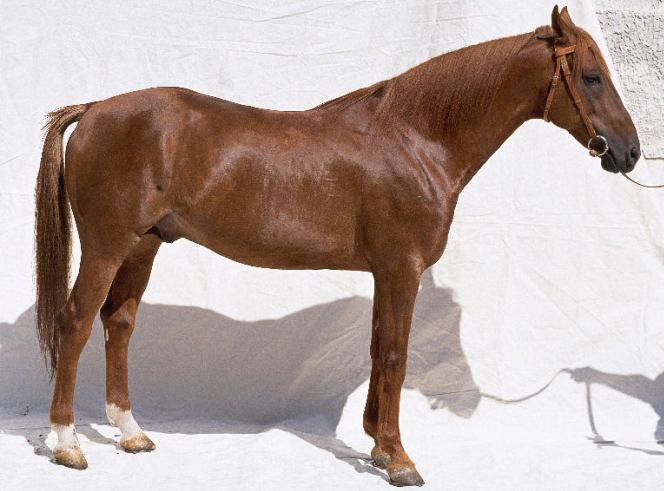
French Trotters are built for efficiency at the trot: compact, strong through the body, with a frame that can sit into the harness and keep rhythm. The defining trait in motion is the ability to maintain a fast, balanced trot under pressure, diagonal pairs working together, without losing the gait.1, 4
Individuals commonly stand around 154 to 164 cm at the withers (about 15.1 to 16.1 hands), though there is real variation. Coats are often chestnut or bay, with other solid colours occurring.1 Because breeding selection prioritises performance over looks, animals can vary a lot, but you will still tend to see:
- a practical, athletic build rather than a show-ring outline
- strong hindquarters for sustained drive
- sound, straightforward limbs suited to repetitive work
The neat "15 to 16 hands, 600 to 700 kg" figures sometimes published as a rule can fit some individuals, but they are not a reliable breed-wide summary. There is no single, universally applied conformation standard for the French Trotter the way many riding breeds have one, and size varies with bloodlines and training history.1
French Trotter or "Norman Trotter"?
The French Trotter is the clearest label of the lot. If you are comparing descriptions online, it helps to separate three overlapping ideas:
- French Trotter (Trotteur Français): a defined French trotting-race breed with a stud-book and a clear industry role in trot racing.1, 5
- Historic Norman carriage and farm types: older regional horses, often grouped under Norman carriage-horse traditions, that contributed to later breeding programs.2
- Anglo-Norman and later French sport-horse development: broader warmblood evolution in Normandy that eventually fed into French sport-horse populations.2
In plain terms, "Norman Trotter" is usually a vague shorthand for "trotter-ish horse from Normandy breeding", not a consistent breed identity. If a description leans on it heavily, check what breed it actually means.
Training and Exercise
In French trotting circles, selection is deeply performance-led: gait, durability and the ability to hold speed at the trot shape breeding choices far more than looks. The industry is organised around dedicated racing structures, and the official French bodies have long been closely involved in developing trot racing and the breed population.5
For owners outside that racing pipeline, the practical point is simple. Many trotters have been conditioned for straight-line, repetitive athletic output, so retraining for riding or non-racing driving takes time. They often need to develop different balance, different muscle use, and a different relationship to speed cues. They can and do transition into pleasure riding, endurance-style conditioning, low-level sport and general driving, especially with a calm temperament and patient handling. Set expectations to match the body: efficient forward movement, stamina and a willingness to work, rather than a naturally uphill, collected sport-horse outline.1, 2
Health and Management
None of the main concerns here are unique to the French Trotter, they are the ordinary risks of any athletic horse, and more so for ex-racers. Hard training loads expose joints, tendons and feet to repetitive stress, so any performance horse deserves a steady, observant routine. Two issues owners worry about most are colic and soundness.
Colic is a horse problem, not a French Trotter problem, made more likely by management swings, especially abrupt feed changes, limited water, and shifts in turnout or stabling. Veterinary guidance consistently points to gradual transitions and predictable routine as the quiet workhorses of prevention.6, 7, 8, 9
- Make feed changes slowly, since even changing hay batches can matter.7
- Prioritise forage and steady access to clean water.6, 8
- Maximise turnout where safe and practical, and keep routines predictable.7, 8
Soundness in a working trotter is mostly about early detection. Watch for heat, swelling, a shortened stride, reluctance on turns, changes in hoof wear, and a subtle loss of push from behind. Keeping hoof care, conditioning and workload changes consistent is what stops a minor strain from becoming a long lay-off.
A Few Things Worth Knowing
Some drafts online treat "Norman Trotter" as a specific, famous French racehorse from the late 1800s or early 1900s, with records that supposedly "still stand today". That claim does not line up with how reputable breed and racing bodies describe the French Trotter's development, and it uses "Norman Trotter" as both a breed and an individual horse without evidence. If you hold a primary source for a particular horse of that name, a stud-book entry, race records, or a recognised racing archive, then name the exact races and dates. Without that, the accurate approach is to drop the "revolutionary figure" storyline and keep to the real breed history.1, 2, 5
The Bottom Line
The French Trotter is a genuine, well-documented breed: a Normandy harness racer bred to hold a fast trot, athletic and hard-working, with a stud-book dating to 1906 and recognition in 1922. It is a solid all-round horse for the right owner, particularly one ready to put in patient retraining if the horse is coming off the track. Just do not confuse it with a vague "Norman Trotter" label, which is regional shorthand rather than a standardised breed of its own.
References
- French Trotter (Trotteur Français), overview, origins, stud-book timing, characteristics
- Anglo-Norman horse, Normandy breeding context and relationship to later French lines (including French Trotter split)
- IFCE (Équipédia): Société d'Encouragement à l'Élevage du Trotteur Français (SETF), history and role
- Irish Horse Board: Irish Standard Bred Trotter, gait definition and functional type description
- Guide Officiel du Galop: SECF/Le Trot, organisational role in French trotting
- University of Minnesota (Open Textbook): Preventing colic, risk factors and prevention steps
- University of Minnesota Extension: Colic in your horse, management risk factors and prevention
- Colorado State University Veterinary Teaching Hospital: How to prevent colic in horses
- UC Davis School of Veterinary Medicine (Horse Report): Colic risk factors and management

Dog lover and writer at My Pets Australia, sharing practical breed guides and care advice for Australian pet owners.