Fish Feeding Stimuli
Fish feeding stimuli are the signals a fish uses to notice food, find it, and decide whether to eat it. Get the cues right and a reluctant tank comes to life; get them wrong and you either starve the quiet fish or foul the water with leftovers. The cues themselves are simple enough, light, movement, smell, timing, but the margin for error is not, because too much food can wreck water quality quickly and too little slows growth and weakens fish over time. Most feeding problems trace back to one of these cues being missing or misused rather than to the food itself. This is a practical, evidence-based look at what actually stimulates feeding, how to use those cues at home and on farms, and the quiet signs that your routine needs adjusting.
What "fish feeding stimuli" means
Fish feeding stimuli are the signals fish use to notice food, locate it, and decide whether to take it into the mouth. In real water, whether murky, bright, flowing or still, fish rely on a blend of senses rather than a single switch. The mix varies by species, life stage, and conditions, which is why one tank responds to a scent trail and another responds to movement.
The main types of feeding stimuli
Visual cues (sight)
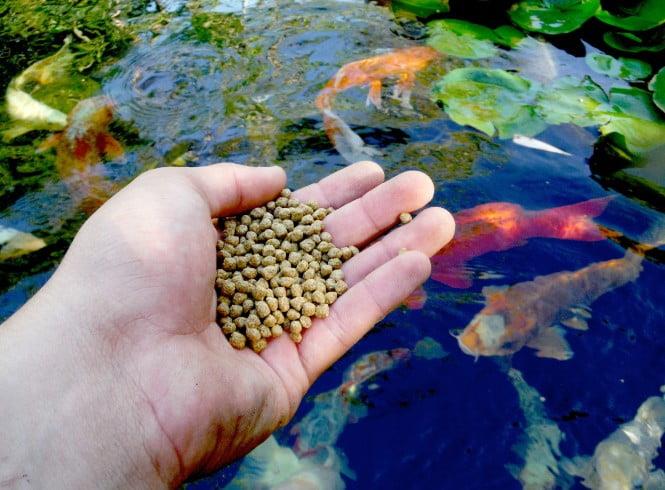
For many daytime species, movement is the first advertisement: drifting flakes, wriggling live food, or pellets that tumble in the current. Contrast helps too, dark food against a pale substrate or pale food against a dark background, especially in clear water under strong lighting. Where visibility is poor, from tannins, algae haze or suspended debris, sight becomes secondary and the other cues carry the load.
Chemical cues (smell and taste)
Dissolved chemicals from food spread as a plume through the water. Many fish detect and respond to food-related odours at very low concentrations, and amino acids are a well-studied example that can act as attractive olfactory cues. 4, 5 In aquariums, this is one reason frozen foods, which release a strong juice as they thaw, can kick-start reluctant feeders, though they also raise the stakes for filtration and portion control.
Mechanical cues (touch, vibration, and water movement)
Fish do not only see food. They also detect fine water movements and vibrations at close range using mechanosensory systems such as the lateral line, which helps with orientation and prey detection when visibility is limited. 6 In practical terms, a gentle current that carries food past a fish's position can be more effective than dropping food into dead-still water where it sinks out of reach.
Timing and routine (predictable patterns)
Feeding response often sharpens when feeding happens at consistent times and in consistent places. In ponds and farms, feed management commonly relies on regular observation and adjusting rations to what fish are actually using, rather than what the schedule says. 2
Using feeding stimuli in a home aquarium
Start with the simplest stimulus: stable conditions
Fish feed best when the basics are steady: temperature, oxygen, and general water quality. A stressed fish may ignore the most tempting food. If feeding behaviour suddenly changes, check for recent changes such as maintenance, new tank mates, filter issues or temperature swings before you start changing foods.
Make the food easy to detect and easy to eat
- Match particle size to mouth size. Too large and fish mouth it and spit it out; too small and it vanishes into the filter or substrate.
- Use movement on purpose. Let pellets tumble briefly in the outflow, or rehydrate dry foods so they drift more naturally.
- Consider the water column. Some species feed at the surface, some mid-water, others on the bottom, so choose floating, slow-sinking, or sinking foods accordingly.
Use smell intelligently for shy or new fish
If fish are hesitant, a small amount of a strong-scented food, for example a little thawed frozen food, can create a chemical trail that helps them locate the meal. Keep it measured, because strong chemical cues often come with more dissolved waste if you overdo it.
Feed less than you think, then watch
In aquariums, overfeeding is one of the quickest ways to degrade water quality. A sensible rule is to feed only what fish will eat quickly, and remove uneaten food. The NSW Department of Primary Industries guidance for aquarium owners is blunt: do not overfeed, and offer only as much as fish will eat in about one minute, or as advised for your species. 1
Feeding stimuli in aquaculture: the same senses, bigger consequences
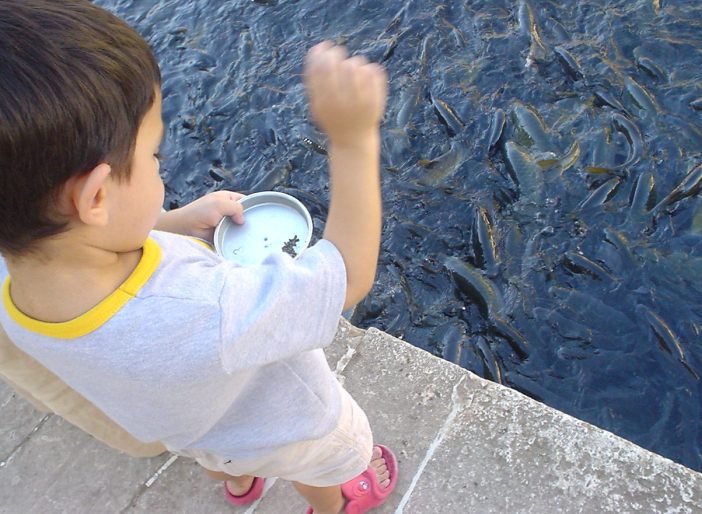
On farms, feed is both the major input cost and a major potential source of nutrient loading if it is not eaten. Uneaten feed and waste are key sources of excess organic nutrients around finfish farms, and careful management aims to minimise these losses. 7 In pond culture, practical training materials emphasise the same balancing act: underfeeding reduces production, while overfeeding is uneconomical and can lead to poor water quality and production losses. 2
Common mistakes when trying to trigger feeding
- Using novelty instead of diagnosis. Swapping foods repeatedly can mask the real issue, whether stress, bullying, incorrect temperature, low oxygen or disease.
- Relying on strong attractants to compensate for a poor routine. If the tank is routinely overstocked or maintenance is inconsistent, more tempting food usually just means more pollution.
- Feeding the loudest fish. Fast mid-water species can intercept everything, so slower feeders may need targeted sinking foods, multiple feeding points, or lights-out feeding for nocturnal fish.
Overfeeding and underfeeding
Overfeeding
Overfeeding commonly leaves uneaten food to break down. In ponds, established guidance notes that overfeeding can result in poor water quality and production losses. 2 In open-water finfish aquaculture, regulators and farmers pay close attention to waste because uneaten feed and fish wastes are the main sources of excess organic nutrients from farms. 7
Underfeeding
Underfeeding is quieter. Fish may look fine while growth stalls and condition slips. In pond culture guidance, underfeeding is directly linked with loss in production, while persistent feed limitation can lead to weight loss and, in severe cases, death from deficiency. 2
Where feeding stimuli research is heading
Modern work continues to map how fish combine vision, smell, taste, and mechanoreception into a single decision to feed, and how this shifts with habitat and light. For keepers and farmers, the useful message stays steady: feeding success is rarely about one magic cue. It is about offering detectable food, at the right size and rate, in conditions where fish feel safe enough to respond.
References
- NSW Department of Primary Industries, Caring for your pet fish
- FAO, Management for freshwater fish culture: supplementary feeds (overfeeding/underfeeding and water quality)
- NOAA Fisheries, Feeds for Aquaculture
- PubMed, Olfactory neural circuitry for attraction to amino acids in zebrafish
- Comparative Biochemistry and Physiology A (1976), Structure-activity relationships of amino acids in fish olfaction
- Zoological Journal of the Linnean Society (Oxford Academic), Flow sensing in the deep sea: the lateral line system of stomiiform fishes
- NOAA Fisheries, Nutrient impacts of finfish aquaculture
- FAO, Management for freshwater fish culture: daily checks and adjusting feeding by utilisation

Dog lover and writer at My Pets Australia, sharing practical breed guides and care advice for Australian pet owners.