Equestrian Mounted Drill Team
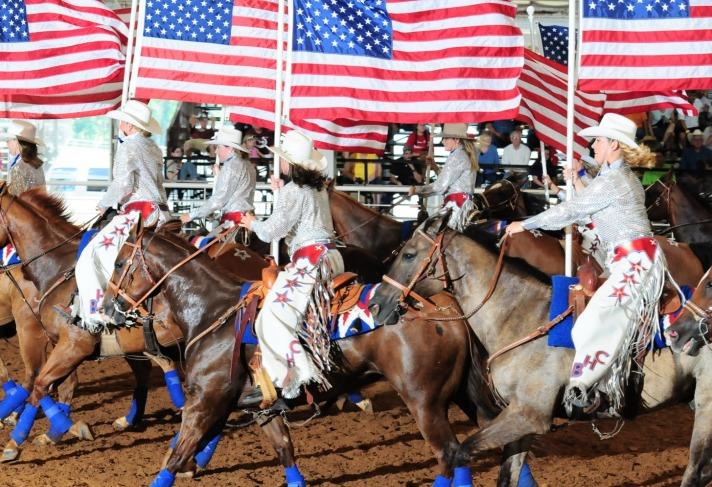
An equestrian mounted drill team is a group of riders performing rehearsed patterns together, usually to music, with the horses travelling in tight formation through circles, diagonals, serpentines and weave patterns. Done well it is calm, precise and genuinely impressive to watch, which is why teams turn up at shows, rodeos, parades and community events. It is also good horsemanship in disguise: the synchronised run on the day sits on top of a long, quiet foundation of control and timing. The riding happens close to other horses, often at speed, with music masking hoofbeats, so it rewards steady horses and conservative progression. This guide covers what mounted drill is, where it came from, what training looks like, and how to make the safety and equipment calls that hold up under pressure.
What is an equestrian mounted drill team?
The aim is synchronisation. Horses travel in formation, change lines cleanly, and hold spacing while moving through set figures such as circles, serpentines, diagonals and weave patterns.1
Teams appear in different settings:
- Exhibition drill at shows, rodeos, community events and parades, where the focus is entertainment and presentation.
- Competition drill, where routines are judged under an event's rules for accuracy, flow, timing and safety. Rules vary by organiser and division.1
Where mounted drill comes from
Mounted formation work has long military roots. Cavalry and horse artillery relied on riders who could move as a unit, respond to signals, and keep discipline in close quarters.
One often-cited ancestor is the Royal Horse Artillery in Britain, a mounted branch formed in 1793 to provide mobile fire support alongside fast-moving units.2 Modern equestrian drill is a civilian sport and performance art, but it borrows that older language of lines, spacing and precision.
In Australia you will still see mounted ceremonial groups and historical re-enactment troops carrying on aspects of mounted display, especially around commemorative events such as ANZAC Day.3 That tradition overlaps in feel with drill, even when the purpose is historical presentation rather than competition.
What joining a drill team involves
Most teams start by matching riders to a safe baseline: steady control at walk, trot and canter, reliable brakes and steering, and a horse that can cope with close riding, noise, banners and music without escalating.
Common entry steps look like this:
- Observe a training session before you ride, so you can see spacing, speeds, and how the team manages risk.
- Do a trial ride, often on your own horse, in a small group, starting at walk and building gradually.
- Agree on expectations: attendance, uniform and tack requirements, and whether the team is exhibition-only or also competes.
If the team competes, ask which organisation's rules they follow and what divisions they enter. Some associations run multiple levels so beginners can start with wider spacing and simpler patterns before moving up.4
Training and practice
Drill training is mostly slow, repetitive and quiet. The polished run is the final layer, and underneath it is a long process of building predictable responses in the horse and consistent timing in the rider.
Foundations
- Transitions that happen on cue without rushing (walk to trot, trot to canter, and down transitions).
- Straightness: holding a line beside another horse without drifting.
- Adjustable stride: lengthen and shorten without losing rhythm.
- Stand and wait: horses that can pause in formation without fidgeting or crowding.
Formation skills
- Spacing: maintaining a consistent distance front-to-back and side-to-side.
- Pass-bys: two lines travelling past each other safely, with clear rules about who holds line and who yields if needed.
- Crossovers: intersecting lines that require timing more than speed.
- Music and noise proofing: practising with speakers, clapping, flags or announcer noise introduced gradually.
Good teams build exit doors into practice: a safe lane to peel out if a horse becomes unsettled, and a calm protocol for rejoining without disrupting others.
Benefits of drill riding
A good drill team is a rare kind of learning environment, with many eyes watching, many horses moving, and a shared need for predictability.
Riders often gain:
- Sharper control of line, pace and transitions under distraction.
- Better arena awareness, because you are constantly tracking other horses' positions.
- Calmer decision-making under pressure, when a pattern tightens or a timing point slips.
These benefits depend on a team culture that prioritises safety over spectacle: steady progression, honest feedback, and the willingness to simplify a routine when the conditions or horses do not suit.
Types of routines you will see
Most routines are built from a small toolkit, arranged into sequences that look complex once the speed and music are added.
Precision drill
Pattern-driven and symmetrical, with an emphasis on matching tempo and hitting marks together. You will often see clean diagonals, circles and mirrored lines, with minimal pauses.1
Exhibition (theme) drill
More flexible in style. Teams may add costumes, flags, props or other show elements where allowed by the venue, while still needing safe spacing and clear right-of-way rules.1
Safety and equipment that matter most
Drill magnifies ordinary riding risks because horses work close together and cues can be harder to hear. Safety starts with predictable horses, conservative progression, and gear that will not fail.
Helmets
In Australia, Equestrian Australia (EA) requires an approved helmet standard for EA competitions, worn with the chin strap fastened, except where specific sport rules allow otherwise. EA lists accepted standards and markings, including AS/NZS 3838 (SAI Global marked) and ASTM F1163 (SEI marked), among others.5
From 1 January 2026, international competition requirements are also tightening under the FEI's staged move to improved helmet standards, with further changes through 1 January 2028. If you compete across organisations, check your helmet's exact certification and date marking before the season starts.6
Core tack and clothing checks
- Bridle and bit: stitching sound, keepers intact, no cracked leather. If a strap fails in a pass-by, you do not get a second chance.
- Saddle fit and girthing: a slipping saddle in formation is a fast route to a fall.
- Boots and stirrups: proper riding boots with a heel, and stirrups that release appropriately for the rider.
- Uniform and accessories: nothing that flaps into a horse's eye line or tangles with reins.
Many clubs and insured venues also set minimum standards for helmets and footwear while mounted, and may treat non-compliance as an insurance issue, not just a preference.7
Training for safety, not just performance
- Introduce flags, banners, music and applause gradually.
- Practise an abort cue: a simple, consistent instruction that means slow down, widen spacing, and return to the rail.
- Keep green horses out of tight patterns until their forward, stop and steering are reliable under distraction.
The bottom line
Mounted drill is at its best when it looks effortless: lines sliding past each other with quiet accuracy, hooves keeping time, riders making small corrections that never need to become big ones. It is a craft built from repetition, trust and a clear-eyed respect for what can go wrong, not a shortcut to excitement. If you are choosing a team, look for the ones that practise slowly, talk plainly about risk, and would rather simplify a routine than force a horse through it. The polish comes later.
References
- Wikipedia · Equestrian drill team (overview and common contexts)
- National Army Museum (UK) · Royal Horse Artillery (formed 1793; origins and purpose)
- Australian Light Horse Association · Our History (association background and activities)
- Southeast Mounted Drill Team Association · Association overview (divisions/levels and competition structure)
- Equestrian Australia · Current approved safety standards for helmets (EA requirements and accepted standards)
- Equestrian Australia · Improved helmet standards to be implemented progressively over 2 years (FEI timeline from 1 Jan 2026 to 1 Jan 2028)
- Hornsby District Agricultural Riding Club · Safety and club rules (example club safety requirements and standards)
- United States Pony Clubs · 2025 USPC safety policy updates (helmet certifications and fastening requirement)
- Equestrian Australia · Helmet standards notes (replacement after impact and rider responsibility)

Dog lover and writer at My Pets Australia, sharing practical breed guides and care advice for Australian pet owners.