English Shepherd
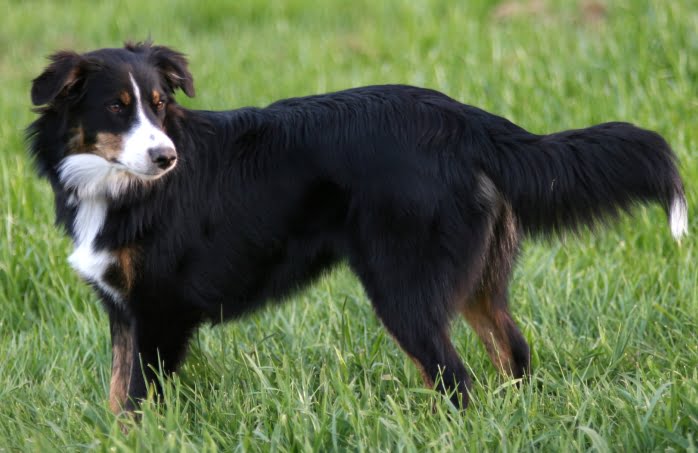
The English Shepherd is a medium, athletic farm dog bred to think for itself: move stock, watch the property, deal with vermin, and then switch into a calm companion when the work is done. Despite the name it is best understood as an American farm collie type, descended from British and Irish stock dogs and then shaped in the United States for all-round farm work.1, 2 People who suit it tend to want a dog with a job in its head, one that is biddable, sensible around livestock, and steady with the family. It is also a serious commitment: a dog bred to notice movement and manage it will find its own work indoors if you do not give it any.
English Shepherd at a glance
- Origin: United States (developed from British and Irish farm collie types).1, 2
- Role: all-purpose farm dog; herding, guarding, vermin control, general help around livestock.2, 3
- Size: typically 46 to 58 cm at the shoulder (bitches 46 to 56 cm; dogs 48 to 58 cm); roughly 18 to 27 kg depending on sex and build.1
- Coat: double coat; straight, wavy, or curly, with short, smooth hair on the face and the fronts of the legs.1
- Common colours: black and white, black and tan, tricolour (black, white and tan), sable and white, tan and white. Merle is not typical and is discouraged or treated as a disqualification by breed clubs and the UKC standard.1, 4
History and Origin
The name gets the story slightly wrong. The modern English Shepherd is generally described as a breed developed in the United States from the working collies brought over by early settlers from Britain and Ireland.2, 3 Over generations those dogs were selected less for show uniformity and more for steady, useful behaviour: moving stock, watching property, and fitting into daily farm life. That history shows up in the dog you meet today, which is alert without being frantic, quick on its feet, and inclined to make its own decisions when work gets messy.
Appearance and Physical Characteristics
English Shepherds are medium dogs with a balanced, athletic outline, built to trot for hours rather than power through in short bursts. In the UKC breed standard, males are typically 48 to 58 cm at the shoulder (51 to 53 cm preferred) and females 46 to 56 cm (48 to 51 cm preferred).1
The coat is practical: a weather-resistant double coat with a softer undercoat for insulation. Texture varies from straight to wavy to curly, with shorter hair on the face and the fronts of the legs, and feathering on the backs of the legs and the tail.1
Temperament and Personality
Well-bred English Shepherds are attentive and responsive with their people, with a natural keep-an-eye-on-things style that suits farm and semi-rural life.3, 5 Many are reserved with strangers rather than instantly social, which is perfectly normal in a working breed, provided it does not tip into fearfulness or reactivity.4 They are often described as versatile all-rounders, able to shift between herding, guarding, and general companionship without needing every moment to be high intensity.2, 3 Versatile does not mean easy for everyone, though. A dog bred to notice movement and manage it will take that job on indoors if the boundaries are unclear.
Is an English Shepherd Right for You?
For most first-time or purely suburban owners, honestly, this is a lot of dog. It suits people who like a dog with a job: close to their people, responsive, and happiest when included in the daily routine. In the right home it makes a steady family dog, but the friction points are predictable: herding behaviours around running children, suspicion of unfamiliar visitors, and a tendency to self-appoint as the household security system. A few safeguards go a long way:
- Supervise child and dog interactions and teach children calm handling. Do not rely on the dog to put up with it.
- Socialise early and carefully with many neutral, positive exposures, especially to visitors at the home.
- Introduce other pets thoughtfully. Many live well with cats and other dogs, but assume there may be chase behaviour until proven otherwise.
Training and Exercise
English Shepherds learn quickly and do best with calm, consistent training: short sessions, clear cues, and rewards that actually matter to the dog. A harsh approach tends to backfire, making a sensitive, observant dog either shut down or argue back. They need daily movement and a reason to use their brains. For many households a good baseline looks like this:
- Physical work: brisk walks, off-lead running in a safe area, hiking, or structured play that does not rehearse bad habits (such as endless high-arousal ball throwing).
- Mental work: obedience foundations, scent games, food puzzles, and, if available, herding lessons or sports that reward steady thinking.
- Real rest: deliberate off switches at home, settling on a mat, crate training if appropriate, and quiet routines after exercise.
Health and Lifespan
No breed is bulletproof. English Shepherds are often described as generally hardy, but they can still be affected by problems seen across many medium herding types, especially orthopaedic and eye issues in some lines.6 The single most useful thing you can do is ask for health screening evidence rather than verbal reassurance. Many breeders and owners use registries such as the Orthopedic Foundation for Animals (OFA) to record hip and eye results.6 Beyond that, watch ears and skin, since active outdoor dogs pick up grass seeds, moisture, and irritants that become expensive if ignored, and build fitness gradually so that athletic dogs get sensible conditioning to protect joints and soft tissues.
Grooming and Care
The double coat is low fuss but not no fuss. Regular brushing helps manage seasonal shedding and reduces matting.5 Avoid shaving the double coat, which can interfere with insulation and weather protection.5 Keep the coat functional rather than fashionable, and it will do its job in most Australian conditions.
A Few Things Worth Knowing
- Broad working brief. The classic job description is wide: move livestock, keep order in the yard, alert to unusual activity, and switch into companion mode when the day ends.2, 3
- Loose-eyed style. They are often described as loose-eyed workers compared with some specialist herding breeds, with less of a hypnotic stare and a more adaptable all-round handling style, though individual dogs vary widely.3
- Uncommon in Australia. The English Shepherd is not a widely recognised purebred through the Australian National Kennel Council system, so here you may see them more often via private rehoming, working-dog circles, or breed-specific communities than through mainstream pedigree channels. Treat any online listing carefully and ask for clear history, temperament notes, and veterinary records.
- Match over label. A genuine English Shepherd should look and behave like a practical farm collie type (athletic, thoughtful, and keen to work with you) rather than a dog defined by unusual colours or marketing claims.1, 4
The Bottom Line
The English Shepherd suits people who want a dog that notices the environment, learns quickly, and expects to be part of the day's moving pieces. Give it training, exercise, and a calm structure, and you tend to get a capable companion that feels quietly competent rather than showy.2, 3 Skip any of those, and the same intelligence that makes it useful becomes a daily management problem.
References
- United Kennel Club (UKC), Breed Standards: English Shepherd
- Wikipedia, English Shepherd (overview and history summary)
- English Shepherd Breed Conservancy, Breed information (background and working role)
- English Shepherd Club, Breed standard (including size and merle disqualification)
- Daily Paws, English Shepherd breed information (coat and general care notes)
- Orthopedic Foundation for Animals (OFA), Health testing and registry information
- Australian Government, Department of Agriculture, Cats and dogs import FAQs (fees and quarantine overview)
- Australian Government, Department of Agriculture, Step-by-step guide for importing dogs (Category 2)
- USDA APHIS, Pet travel from the United States to Australia (export guidance)

Dog lover and writer at My Pets Australia, sharing practical breed guides and care advice for Australian pet owners.