Discovering the Band-Tailed Pigeon: A Comprehensive Guide
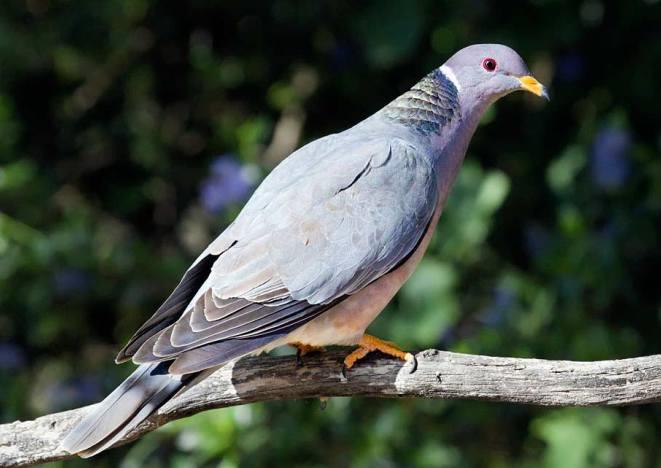
The band-tailed pigeon (Patagioenas fasciata) is a large native pigeon of the Americas, built for forest country rather than city streets. It is a handsome bird, stocky and long-tailed, that gathers in sizeable flocks and travels with the seasons in parts of its range. Australians will not meet it in the wild here, as it is a bird of the Pacific coast forests and the mountain woodlands of the western United States, Mexico and Central America, so this is an identification and natural history guide rather than a pet care guide. It is sensitive to habitat change and disease, which is why accurate identification and context matter.1, 2
Quick identification
The giveaway is the shape: a large, heavy pigeon with a long, rounded tail and thick-based, pointed wings. At close range, look for a thin pale collar on the nape, a yellow bill with a darker tip, and yellow legs and feet.1, 3
- Length: about 33 to 40 cm1
- Weight: about 342 to 364 g1
- Tail pattern: a broad pale band towards the tail tip, most obvious in flight3
Where they live
In North America the band-tailed pigeon has two main breeding regions. One is the wet forests along the Pacific coast, from southeastern Alaska down to California. The other is the drier mountain forests of the south-western United States, extending south through Mexico and Central America.2
Along the Pacific, the birds nest in conifer forests and feed in nearby fruiting shrubs and broadleaf trees. In the interior south-west, they favour mixed pine and oak forests with berry-producing shrubs, often at higher elevations.2
Seasonal movement varies by region. Many birds breeding in south-western British Columbia move south to overwinter, often into Oregon and California, while some populations farther south are more resident.4
Diet and behaviour
The band-tailed pigeon eats mainly seeds and fruit, with acorns often becoming important when they are available. Its diet shifts through the year with whatever is ripening or dropping, so berries carry one season, acorn mast another, and buds and flowers at times.5, 6
These are gregarious birds, commonly seen in flocks that can number a few hundred. In flight they look purposeful and direct, moving between feeding areas and forest cover with quick wingbeats. During breeding, much of the activity stays high in the canopy, where courtship and nest-building are tree-based, and pairs may nest loosely near one another rather than in tight colonies.2, 5
Breeding
Reproduction here is slow. Band-tailed pigeons usually lay a single white egg, though two can occur, and both parents share incubation and feeding of the chick, including the crop secretion known as pigeon milk. In good conditions a pair may attempt more than one brood in a season, but overall output stays low compared with many other birds.2, 5
Conservation status and threats
Globally the band-tailed pigeon is listed as Least Concern, but that broad category can hide regional problems. Some well-studied populations, particularly along the Pacific coast, have shown long-term declines over decades.2, 7
The main pressures are:
- Habitat change that reduces the fruit- and nut-producing shrubs and hardwoods the birds rely on for feeding, even when nesting trees remain.6
- Low reproductive rate, which makes recovery slower after poor years or heavy losses.6
- Disease, especially avian trichomonosis, caused by Trichomonas gallinae, which can spread at shared water sources and cause severe throat lesions that lead to starvation or suffocation.8, 9
- Hunting in parts of the range, managed under migratory bird frameworks and local regulations that can change year to year.2, 10
Living near people
Within their range, band-tailed pigeons turn up in suburbs and rural towns, often drawn to berrying trees, bird feeders, or reliable water. If you are seeing sick birds or sudden deaths, disease control matters more than feeding.8
- If multiple birds appear unwell, remove feeders and bird baths temporarily and empty standing water features used by birds.8
- Keep water sources clean when birds are present, and avoid creating crowded hotspots where many birds drink in a small space.8
- Plant or protect fruiting and mast-producing natives, where appropriate for your region, to support natural foraging rather than dependence on handouts.2, 6
Common misconceptions
- They are mountain birds only. Some populations do breed in higher, drier mountain forests, but Pacific birds also use lowland coastal forests and edges.2
- They always lay two eggs. Most nesting attempts involve a single egg. Two is possible but less typical.2, 5
- The population is stable everywhere. The global category is Least Concern, but long-term declines have been documented in parts of the range, especially the Pacific coast population in the United States.2, 6
References
- Cornell Lab of Ornithology (All About Birds), Band-tailed Pigeon: Identification
- Cornell Lab of Ornithology (All About Birds), Band-tailed Pigeon: Life History
- Government of Canada, COSEWIC assessment and status report: Band-tailed Pigeon (2021)
- Government of Canada, COSEWIC assessment and status report: Band-tailed Pigeon (2008)
- National Audubon Society, Band-tailed Pigeon (Field Guide)
- California Department of Fish and Wildlife, Band-tailed Pigeon (species information)
- National Geographic, Band-tailed Pigeon facts
- California Department of Fish and Wildlife, Avian parasite responsible for band-tailed pigeon deaths (avian trichomonosis)
- U.S. Geological Survey (National Wildlife Health Center), Trichomonosis overview, case example and background
- U.S. Fish and Wildlife Service, Migratory Bird Hunting Regulations (framework and annual process)

Dog lover and writer at My Pets Australia, sharing practical breed guides and care advice for Australian pet owners.