Cowboy Mounted Shooting
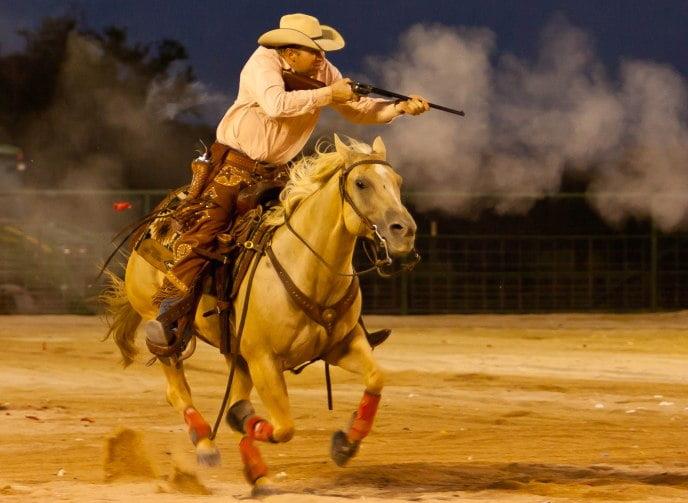
Cowboy Mounted Shooting is a timed equestrian sport where a rider gallops a set pattern and pops a series of balloon targets from horseback, using two single-action revolvers loaded with blanks. It is fast, loud and genuinely fun to watch, and the good runs look effortless because the groundwork behind them is anything but. The sport sits right at the meeting point of horsemanship and firearms handling, which is exactly why it runs on strict rules rather than bravado. Done properly it is tightly controlled; done casually it gets unsafe quickly. This guide covers how the sport works in Australia, the gear involved, and the safety and legal checks that matter most.
What Cowboy Mounted Shooting Is (and Isn't)
The core of the sport is simple: a rider navigates a course and engages a total of ten balloon targets during a run, usually carrying two single-action revolvers.1, 2
It is not live-ammunition target shooting. Matches use blanks designed to reliably break balloon targets at short range, and live rounds are prohibited at competitions. The blanks rely on the blast and unburnt powder rather than a bullet, which is why target placement and minimum distances matter so much.1, 2
A Brief History
Mounted shooting has roots in Wild West exhibition culture, where riders demonstrated speed, control and firearms handling for crowds. The modern sport was formalised in the United States in the 1990s with the creation of the Cowboy Mounted Shooting Association (CMSA), and the rules and equipment style still reflect that Old West single-action tradition.2, 3
In Australia, participation tends to sit alongside established western and single-action shooting communities. The same general principles apply: strict firearm control, reactive targets and disciplined range-style procedures, just with a horse under you.4
How a Typical Stage Works
A run is short and busy. The horse accelerates into the pattern, bends around the markers and steadies just enough for the rider to place each shot where it needs to be.
- Ten balloon targets are set in an arena pattern.
- The rider enters one at a time, on a start signal once the arena is clear.
- Targets are engaged with blank cartridges at close range.
- Time is recorded, with penalties added for misses and course errors.
Exact patterns and penalty systems vary by organising body, but the structure of speed plus accuracy under control stays consistent.2
Equipment You Actually Need
Horse and tack
The horse needs to stay calm around sharp sound, sudden movement and the rider's one-handed rein work. Tack is typically western, chosen for stability and clear cues at speed, but the right saddle is simply the one that fits the horse and lets the rider stay balanced through the turns.
- Well-fitted saddle (commonly western style), with girth or cinch in sound condition
- Breastplate or breast collar if needed to keep the saddle stable in fast work
- Reins suited to one-handed control (depending on training and rule set)
Firearms and ammunition
Most rule sets specify fixed-sight, single-action revolvers in .45 Colt (or historically styled equivalents), carried in a secure holster system. CMSA rules, for example, restrict competition revolvers to fixed-sight single actions of .45 Colt calibre, designed prior to 1898 or reproductions of that style.3
Competitions use blank ammunition, not projectiles. These blanks are formulated to break balloon targets at short distance.2, 3
Rider protective gear
Clubs and sanctioning bodies set different requirements, but in Australia it is sensible to treat a compliant riding helmet as non-negotiable, especially when you are combining speed, horses and firearms handling. Equestrian Australia publishes a list of approved helmet standards for EA competitions (including AS/NZS 3838 and several international standards), and requires helmets to be worn with the chin strap fastened when an approved helmet is required.5
- Approved riding helmet, correctly fitted and fastened5
- Eye protection, strongly recommended in any arena with dust, debris and powder residue
- Long sleeves, long trousers, and boots with a heel
- Protective vest (club-dependent; worth discussing with local organisers)
Training: What Matters Before You Go Fast
The sport looks like pure speed, but the foundation is quiet repetition. The horse learns that noise is just noise, and the rider learns that safe muzzle control does not change when the horse shifts underneath.
- Horse desensitisation. Start away from competition intensity, with controlled exposure to sound and movement.
- One-handed riding control. Steady turns, straight lines and reliable brakes while the other hand is occupied.
- Firearms handling habits. Safe holstering and drawing, muzzle discipline, and consistent loading and unloading routines.
- Pattern familiarisation. Walk and trot the shapes first, and let speed arrive later.
Safety: The Non-Negotiables
Mounted shooting borrows its safety backbone from both equestrian sport and range practice. Details differ by club, but every good event feels the same: controlled entry, clear commands and no shortcuts.
- Only blank ammunition in the arena. Live rounds are prohibited at competitions.3
- One rider at a time on course, with a clear start signal once the arena is confirmed clear.1
- Muzzle discipline at all times, including during holstering and dismounting.
- Gear checks before runs: tack, holsters and firearm function.
- Plan for horse welfare. Heat, footing and fatigue show up faster when adrenaline is doing the driving.
Legal and Admin Checks in Australia
Do not skip this part. Firearms licensing, transport and storage rules are set at state and territory level, and they are enforced. If you are travelling to events, build your routine around compliance, not convenience.
As a plain-language baseline:
- In NSW, safe storage requirements depend on firearm category, and ammunition must be locked separately (it may be in a separate locked container within the main container).6, 7
- Queensland Police advise, as a general rule, against storing weapons in vehicles. If it is unavoidable, strict conditions apply: locked away, out of sight, and not left unattended in an unsecured way.8
If you are new, your safest next step is to talk to a local club or range that already runs mounted shooting and ask exactly which licences, permits and storage arrangements apply in your state.
Types of Events and Getting Involved
People often describe stages as either speed or precision, but in practice most competition patterns ask for both: fast lines, tight turns, and shots that still need to land within a small window of distance and angle for the balloon to break reliably. Some clubs also run introductory or clinic days focused on safe handling and horse exposure, and larger organisations use class-based competition to separate newer riders from experienced combinations.3
One note on the online chatter: names and nicknames of famous competitors circulate easily and are often repeated without verification. If you are looking for recognised champions, check the results and leaderboards published by the sanctioning body or host club, rather than relying on unsourced lists.
If you want to try it, work through these steps:
- Watch an event first, in person if you can. Listen to the range-style commands and how riders enter and exit the arena.
- Find a club that can support both sides: horsemanship coaching and licensed shooting supervision.
- Confirm legal requirements early: licensing, safe storage at home, and compliant transport to and from venues.6, 7, 8
- Start with calm exposure. Horses that tolerate noise without tension are made, not found.
In Australia the sport will grow where it stays disciplined: clear rules, a serious safety culture, and horses trained with patience rather than pressure. The spectacle is real, but it only works because the groundwork is quiet and methodical.
References
- Cowboy mounted shooting (overview, typical course format and penalties), Wikipedia
- Cowboy mounted shooting (blank ammunition and balloon targets at short range), Wikipedia
- Cowboy Mounted Shooting Association (CMSA), About / equipment and ammunition notes
- Sporting Shooters' Association of Australia (SSAA), Single Action discipline overview (firearm types and tradition)
- Equestrian Australia, Current approved safety standards for helmets
- NSW Police, Safe storage (firearms owner responsibilities and storage levels)
- NSW Government (Sydney International Shooting Centre), General rules of firearms storage
- Queensland Police Service, Safe storage of weapons and ammunition (including vehicles)

Dog lover and writer at My Pets Australia, sharing practical breed guides and care advice for Australian pet owners.