Charreada
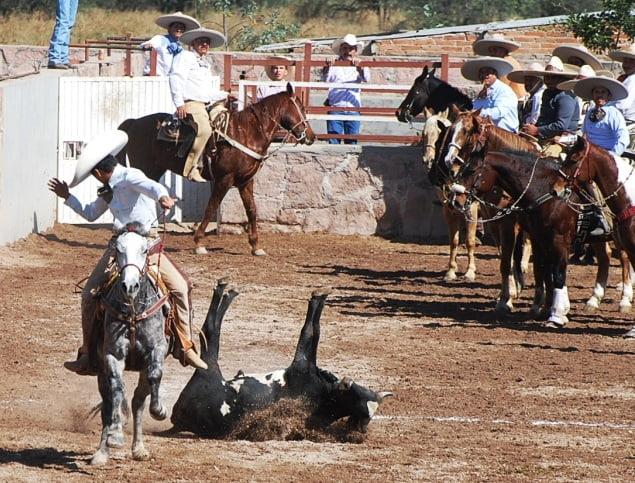
Charreada is Mexico's national equestrian sport, a scored contest of roping and precision horsemanship performed in a purpose-built arena by riders known as charros. It often gets summarised in English as a "Mexican rodeo", but that shorthand undersells it. Most of what you see is controlled, technical work: a horse stopped and turned on command, a rope thrown with intent, a heavy animal handled inside strict limits of time and space. It carries real cultural weight, with traditional dress, specialist crafts, music, and tight community networks all woven through it.1 This guide sets out what happens in the arena and why it matters.
What charreada and charrería mean
The two words are easy to mix up. Charrería is the broader equestrian tradition of the charros, Mexico's horsemen and horsewomen. A charreada is the organised competition or performance where those skills are presented and scored in front of an audience.1 UNESCO describes charrería as a traditional practice that grew from livestock-herding communities in Mexico, with techniques passed down through families and now also taught through associations and schools, including up to competition level.1
From working stock skills to sport
Charreada began as ordinary work. UNESCO traces charrería to livestock-herding communities in Mexico in the sixteenth century, where methods were developed for managing animals and later formalised and presented publicly as competitions.2 The practical tasks, roping, controlling a horse at speed, and handling a powerful animal in a confined space, became suertes (scored events) with defined rules, a set order, and judging standards.
What happens in a charreada
A modern charreada is usually a team competition, with competitors building points across a set sequence of events. The "bull riding and bronc riding" framing common in online summaries is too narrow. Much of charreada is precision horsemanship and roping technique, with the animal handled under tight time, space, and scoring constraints.3
Commonly referenced events
- Cala de caballo (testing the horse): controlled stops, rein-backs, turns, and overall responsiveness.
- Piales en lienzo: roping a mare's hind legs, timed and scored for technique.
- Coleadero (colas): bringing a bull down by tailing, performed in a defined lane and judged on execution.3
- Escaramuza charra (women's event): synchronised mounted routines, traditionally ridden sidesaddle, with judging focused on formation, timing, and control.1
Exact event lists and scoring details are set by the sport's governing bodies and competition regulations, and can vary by category and rule updates. For official competition rules, refer to the Federación Mexicana de Charrería (FMCH).6
The arena: the lienzo charro
Charreadas take place in a lienzo charro, a purpose-built facility with two main sections: a long rectangular lane (manga) leading into a circular arena. The Spanish-language overview notes minimum measurements specified in FMCH competition regulations, a circle of at least 40 metres in diameter connected to a lane 60 metres long by 12 metres wide.7 The shape is functional. Some events need the straight run of the manga, while others unfold in the round arena, where speed and turning ability show clearly.
Attire and equipment
The traditional clothing is part of the practice, not decoration added later. UNESCO describes the characteristic outfit, a wide-brimmed hat for the charro and a colourful shawl for the charra, along with the locally made gear that supports the tradition, including saddles, spurs, and leatherwork.1 In a well-run charreada the details register: the weight of the saddle, the crisp fall of embroidered fabric, the controlled coil and release of the reata (rope). Much of this depends on artisans whose work is part of the same cultural ecosystem.1
The role of horses
Horses are central here, not just as transport but as trained partners for very specific manoeuvres: tight turns, abrupt stops, precise positioning for a rope throw, and sustained control under noise and movement. "Good riding" in this context means the horse holds its composure and answers quiet, exact cues. UNESCO notes that charrería is transmitted through families and through associations and schools, which train participants up to competition level.1
Why charreada matters in Mexican culture
Charrería is widely presented as a defining national tradition, closely tied to community identity and continuity. UNESCO frames it as an important aspect of the identity of bearer communities and as a vehicle for passing social values through generations.1 It is internationally recognised too: Charrería, equestrian tradition in Mexico, was inscribed in 2016 on UNESCO's Representative List of the Intangible Cultural Heritage of Humanity.2
Charreada today
The sport continues through organised clubs, formal competitions, and local schools. That same visibility brings scrutiny, particularly around animal welfare and how different events are conducted in practice. If you are attending, filming, or researching a charreada, look for signs of strong governance: clear event marshals, competent stock handling, veterinary presence where expected, and adherence to current competition regulations. The rules and updates are managed through the Federación Mexicana de Charrería and its published materials.6
The Bottom Line
Charreada is best understood as skilled stock work shaped into formal competition, carrying craft, clothing, music, and community memory along with it. Strip away the shortcuts, "just bull riding", "just a rodeo", and what is left is a disciplined, highly specific tradition: horses trained for precision, ropes thrown with intention, and a public ritual that still connects back to the working landscapes it came from.1
References
- UNESCO Intangible Cultural Heritage, Charrería, equestrian tradition in Mexico
- UNESCO ICH, Decision of the Intergovernmental Committee: 11.COM 10.B.22 (Charrería nomination decision)
- UNESCO Intangible Cultural Heritage, Video: Charrería, equestrian tradition in Mexico
- UNESCO Intangible Cultural Heritage, Mexico (state page and listed elements)
- UNESCO Multimedia Archives, Charrería, Equestrian Tradition in Mexico (documentary record)
- Federación Mexicana de Charrería (FMCH), Official site
- Wikipedia (Spanish), Lienzo charro (includes dimensions attributed to FMCH competition regulations)
- UNESCO ICH, Charrería listing (film embed page)

Dog lover and writer at My Pets Australia, sharing practical breed guides and care advice for Australian pet owners.