Calf Roping
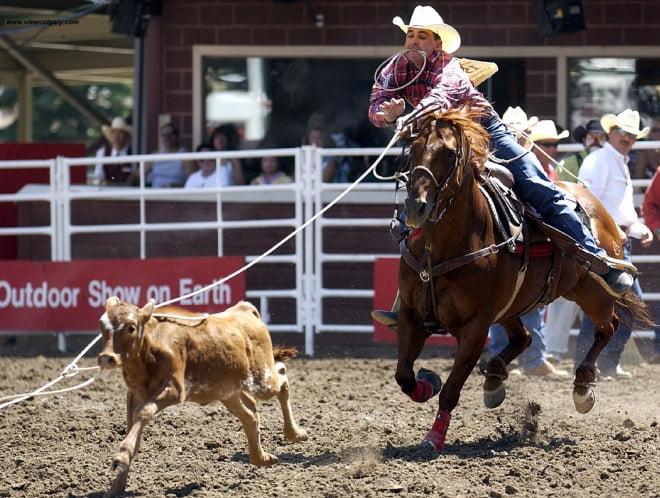
Calf roping, also called rope and tie or tie-down roping, is a timed rodeo event where a mounted competitor ropes a released calf, dismounts, and ties three of its legs against the clock. It grew directly out of practical cattle handling before it moved into competition, and a good run rewards real horsemanship: quiet tracking, clean rope delivery, and a fast, controlled tie. It is also one of the most contested events in the arena, with animal welfare groups arguing it causes distress and injury even when the rules are followed. In Australia the standards vary by state and by rodeo association, so the details of any given event depend on where it is run. This guide explains what actually happens, what the rules are meant to prevent, and why the event stays under scrutiny.1, 2, 3
What happens during a run
A calf is released from a chute with a short head start. The competitor follows on horseback, ropes the calf (typically around the neck), dismounts, and ties three legs in what is called a three-legged tie. The clock stops when the tie is completed, then the calf must stay tied for a short tie-check period before it can be released.2, 3
Australian welfare codes and rodeo standards generally include a 30-second time limit for rope and tie, and require competitors to withdraw if they have not roped by the time the calf reaches the far side of the arena, or within that 30-second window, depending on the code.1, 4
Where it came from: ranch work to rodeo
The core skills, catching, restraining, and briefly holding young cattle, come from stock work where animals need to be drafted for treatment, marking, or other routine handling. In rodeo those actions are compressed into seconds and judged mainly on time. That is why the rule sets lean so heavily on safety constraints and disqualification conditions: the clock rewards speed, so the rules have to draw the lines everything else has to stay inside.2, 1
Rules and welfare standards in Australia
Australian states and rodeo bodies set minimum welfare requirements aimed at reducing abrupt stops, dragging, and rough handling once the rope is on. Queensland's mandatory rodeo code, for example, sets minimum calf weights, limits how many times a calf can be used per day (with rest periods), and prohibits actions such as pulling a calf backwards off its feet, sudden stops, throwing the calf onto its spine, or dragging it more than 1 metre.1
Many standards also require a roping safety device, a shock-absorber style device approved by the rodeo association, intended to reduce the force transmitted to the calf and horse when the rope comes tight.1, 3
Common rule themes across codes and association standards include:
- Time limits and withdrawal rules to prevent prolonged chasing and repeated catches.1, 3
- No jerk down and no dragging, with disqualification if an animal is pulled backwards off its feet or dragged.3, 4
- Immediate rope removal once the judge signals the tie is complete.1, 4
- Limits on animal use (how many runs per day, with rest), plus minimum weight thresholds in some jurisdictions or associations.1, 6
Equipment: what is actually used
At its simplest, calf roping uses a rope, a suitable saddle and tack, and protective gear for the rider. The details matter, because small changes alter how force is applied and how a horse can hold position after the catch.
Rope (lasso or lariat)
The rope is built to form a clean, consistent loop that will deliver over distance and then hold. Materials vary, often synthetic blends, and the rope's stiffness and diameter affect how it throws and how it feels in the hand. Competitive ropers choose a rope that matches their throwing style and local conditions such as dust, humidity, and arena footing.
Roping safety device
In parts of Australia, competitors must use an approved roping safety device intended to reduce peak forces when the rope comes tight. Queensland's code explicitly requires a roping safety device for rope and tie.1
Saddle and tack
Roping saddles are designed for stability during acceleration and tight turns, and for controlled rope handling, including the way the rope is managed around the saddle horn. Many welfare codes also include requirements around horse gear to prevent animals being dragged and to keep handling within clear limits.4
Rider protective gear
Ropers commonly wear boots with a defined heel, a glove for rope handling, and protective items that depend on the event and association, for example helmets in junior divisions. Standards vary by organisation and age group.
Technique and the horse's role
Good runs look quiet from the stands. The horse tracks straight and stays balanced, the rope leaves the hand cleanly, the calf is caught early, then everything slows into a controlled dismount and a fast, tidy tie. Instruction varies between roping schools, but most of it circles the same fundamentals:
- Position: staying aligned so the rope lands cleanly without forcing sharp angles.
- Timing: throwing early enough to avoid a long chase, which increases stress and risk.
- Control after the catch: riding and handling the rope in a way that avoids abrupt stops, dragging, and illegal jerk-down outcomes.1, 3
- Efficient tying: a secure three-leg tie within the allowed time window, followed by immediate release once the judge's tie check is satisfied.2, 4
The horse does far more than chase. It has to leave the box calmly, rate its speed to match the calf, hold a line that gives the rider a fair throw, then respond instantly after the rope is on, often standing the rope and staying clear while the rider dismounts and ties. The most suitable rope horses share a few traits: quick acceleration, strong stopping ability without scrambling, and a steady response under noise and movement. Training focuses on responsiveness and consistency, because small misreads can turn into sharp angles, extra tension, or a disqualification.
Welfare, risks and controversy
Rulebooks talk in the language of disqualifications, but the underlying concern is welfare and safety. Sudden deceleration, falls, rope pressure to the neck, and rough grounding can injure calves, and horses and riders can also be hurt in fast turns or tangled ropes.
Animal welfare groups argue that calf roping inherently creates distress and a meaningful risk of injury even when the rules are followed, and have called for bans or tighter restrictions in Australia.5, 7 RSPCA sources describe rope and tie as raising particularly serious concerns, citing risks such as neck and windpipe injury, bruising and fractures during grounding, and choking if dragging occurs.5
Rodeo organisations, by contrast, point to codes of practice, veterinary oversight in some jurisdictions, and the use of equipment standards and welfare officers to manage risk and enforce minimum standards.1, 8 Government codes in places like Queensland set detailed minimum standards for animal selection, handling, rest periods, and prohibited actions, and require record-keeping and welfare roles at rodeos.1, 9 The controversy sits on two questions: whether the event can be made acceptably safe through regulation, and whether the stress response seen in calves is compatible with modern animal welfare expectations.
Competitions and regulation in Australia
Australia has many rodeos run by different associations, often with their own rulebooks and pathways. There is no single, universal national finals for calf roping that applies across the whole sport. If you want to verify how an event is run, the most reliable approach is to check the state code, where one exists, and the rodeo association running that program.1, 8
Some jurisdictions and organisations treat calf roping differently from similar roping events such as breakaway roping, which can carry distinct welfare requirements and equipment rules.1 The clearest direction in Australia has been tighter welfare framing around roping events: explicit minimum weights, clearer disqualification outcomes for rough handling, and more emphasis on roping safety devices and prompt rope removal.1, 3 Another visible shift is the growth of breakaway roping in some programs, a format that avoids the tie-down step and is often promoted as a different style of roping competition, with its own welfare rules and restrictions.1
The Bottom Line
Calf roping is a short, technical event built on old stock-handling skills, sharpened into a timed contest that depends on the horse as much as the rider. In Australia it sits under a patchwork of association rules and state-based welfare codes, with firm limits meant to prevent dragging, abrupt stops, and excessive force, and under ongoing criticism from welfare groups who say those limits do not go far enough. If you are watching, competing, or assessing a local rodeo, the most useful question is not whether it is legal, but which code and association rules apply here, and how they are enforced on the day. That is where the real differences show up.1, 8
References
- Business Queensland (Queensland Government), Rodeo code of practice
- American Quarter Horse Association (AQHA), Tie-down roping overview
- National Rodeo Council of Australia, Animal welfare standards (includes roping and tying)
- NSW Department of Primary Industries, Code of Practice for animals used in rodeo events
- RSPCA Australia Knowledgebase, Animal welfare issues with calf roping in rodeos
- Australian Rodeo Federation, Current standards for care and treatment of rodeo (notes on roping and tying)
- ABC News (ABC Rural), RSPCA view and calls regarding calf roping
- National Rodeo Association (Australia), Animal welfare statement and compliance notes
- Queensland Legislation, Animal Care and Protection Regulation 2023 (relevant provisions for rodeo animals)

Dog lover and writer at My Pets Australia, sharing practical breed guides and care advice for Australian pet owners.