Blue-throated Macaw
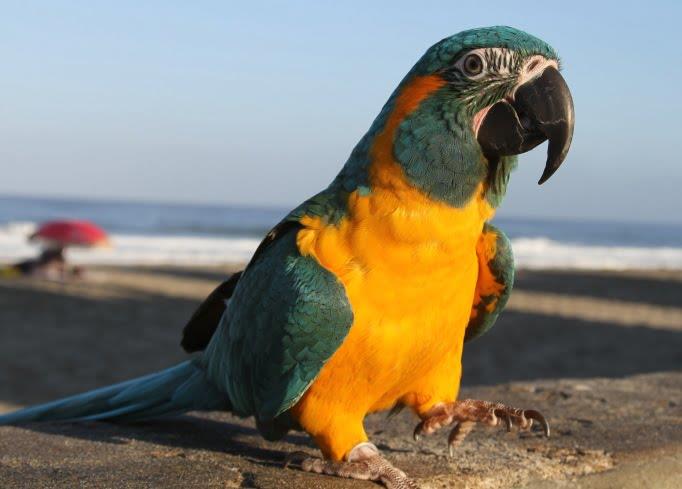
The Blue-throated Macaw (Ara glaucogularis) is one of the rarest parrots on earth, a vivid blue-and-yellow bird with a turquoise throat that survives in a single pocket of northern Bolivia. Most people find it after seeing a photo and wanting to know what it is, where it lives, and why it is so scarce. The honest answer is that it is critically endangered, tightly controlled under international trade rules, and not a bird you can realistically or ethically keep as a pet. What follows is a plain guide to the animal itself: where it lives, how it behaves, and what is being done to keep it going.1, 2, 3
Quick facts (at a glance)
- Common name: Blue-throated Macaw
- Scientific name: Ara glaucogularis
- Adult size: about 70 to 85 cm long (head to tail)4
- Adult weight: roughly 0.9 to 1.2 kg4
- Lifespan (captivity): up to around 50 years, as often reported for large macaws4
- Where it lives: Llanos de Mojos (Beni Department), northern Bolivia2, 3
- Conservation status: Critically Endangered (IUCN)1
- International trade status: CITES Appendix I5
Habitat and range
The Blue-throated Macaw is endemic to a small part of Bolivia, centred on the Llanos de Mojos in the Beni Department. It lives in a seasonally flooded mosaic of open savanna, wetlands, and scattered palm forest "islands" that rise slightly above the surrounding plains.2, 3
These birds are not spread widely across Bolivian tropical forests in general. Their distribution is patchy, and the places that matter most are the ones with the right palms for food and the right trees, or suitable substitutes, for nesting cavities.2, 6
Much of the fieldwork and recovery effort is concentrated in protected areas and private reserves in Beni, including the Barba Azul Nature Reserve and the Laney Rickman Blue-throated Macaw Reserve, where habitat protection and nest-site support have been central tools.7, 8
Identification and physical features
At a glance, the Blue-throated Macaw looks like a close cousin of the Blue-and-yellow Macaw, but the throat gives it away: a vivid turquoise-blue "beard" running down the throat and upper chest, paired with yellow underparts and blue upperparts.4 Other common field marks include a large black bill and bare facial skin with fine dark feather lines around the eye, typical of many macaws.4
Diet and feeding
In the wild, Blue-throated Macaws feed heavily on palm fruits, especially from Attalea and Acrocomia palms. Their movements across the landscape tend to follow food availability, shifting as palms fruit at different times and in different places.2, 6
Captive diets can be varied, but the distinction worth keeping clear is that what a bird will eat is not the same as what best supports long-term health. Anyone seeking husbandry advice should rely on avian veterinarians and specialist parrot-care references rather than general pet guidance.
Behaviour and breeding
Most observations describe Blue-throated Macaws in pairs or small groups, with larger gatherings at shared roosts or feeding areas. Like other macaws, they are strongly vocal, using loud calls that carry well across open savanna and palm forest edges.2, 6 They are often described as socially bonded birds, and long-term pair association is commonly reported for macaws, though "mates for life" is best treated as a tendency rather than a rule.
Breeding is the pinch point. Blue-throated Macaws nest in tree cavities, and suitable hollows are scarce in a landscape shaped by long-term ranching, burning, and the removal of large trees.9 Clutches are usually reported as 2 to 3 eggs, with breeding linked to the seasonal cycle in the Beni lowlands. Where natural cavities are limited, well-designed nest boxes can improve nesting opportunities, but they do not replace the need for mature trees and functioning habitat over the long term.2, 9
Threats and how many are left
The decline of the Blue-throated Macaw has been driven by a familiar combination: a very small natural range, pressure from trapping (historically a major problem), and habitat change that reduces both food resources and nest sites. Low breeding success, often linked to nest failure, predation, and competition for cavities, adds another hard constraint to recovery.3 Because the population is so small, even modest losses matter. A few failed breeding seasons, a localised habitat shift, or sustained illegal take can echo for decades in a long-lived bird that reproduces slowly.
The IUCN lists the species as Critically Endangered. Recent summaries commonly express the population in terms of mature individuals, with figures in the low hundreds, and the overall trend is often described as stable under active management.1, 2 You will also see broader total-individuals estimates used in conservation communication. Different methods count different things (mature birds versus all birds, minimum confirmed counts versus modelled estimates), so the cleanest approach is to treat any single number as a snapshot rather than a certainty.2, 3
Trade, legality, and keeping one
The Blue-throated Macaw is listed on CITES Appendix I, which places the strictest controls on international trade and generally rules out commercial trade across borders, except in limited circumstances such as certain non-commercial movements with the right permits.5 Australia is a party to CITES, so those same controls govern any movement of the species here, and importing one for the pet trade is not a realistic prospect.
Beyond legality, there is the practical reality: large macaws are powerful, long-lived, and demanding. Even where captive-bred birds exist, the conservation status of the species makes any purchase decision ethically weighty. If your interest is conservation-focused, supporting reputable on-ground habitat and nest-site work tends to do far more good than private ownership.
A few common questions
Is the Blue-throated Macaw Australian? No. It is native to Bolivia, in South America.2, 3
Does it live in rainforest? Not primarily. It is strongly associated with the flooded savannas and palm forest islands of the Beni lowlands rather than broad tropical rainforest.2
Why are nest boxes such a big deal? Because nesting cavities are limited. Nest boxes can compensate for the shortage of suitable hollows and lift breeding success at key sites, buying time while longer-term habitat recovery catches up.7, 9
The bottom line
The Blue-throated Macaw is a spectacular bird with a genuinely fragile hold on survival, confined to one region of Bolivia and dependent on active protection to hold steady. It is not a pet, and in Australia the international trade rules make that clear. The best way to engage with the species is to learn about it and back the field programs keeping it alive.
References
- The IUCN Red List of Threatened Species (search: Ara glaucogularis)
- World Parrot Trust, Blue-throated Macaw (species overview)
- U.S. Fish & Wildlife Service, Final rule listing the Blue-throated Macaw (Oct 3, 2013)
- National Geographic, Blue-throated macaw facts
- CITES, Ara glaucogularis listing (Appendix I)
- World Parrot Trust, Blue-throated Macaws: surveys and fieldwork
- BirdLife International, Success in the savannah: saving the Blue-throated Macaw
- Asociacion Armonia, Barba Azul Nature Reserve nestbox updates (July 2019)
- American Bird Conservancy, Blue-throated Macaw (threats and nest box needs)

Dog lover and writer at My Pets Australia, sharing practical breed guides and care advice for Australian pet owners.