Blue-Headed Pionus
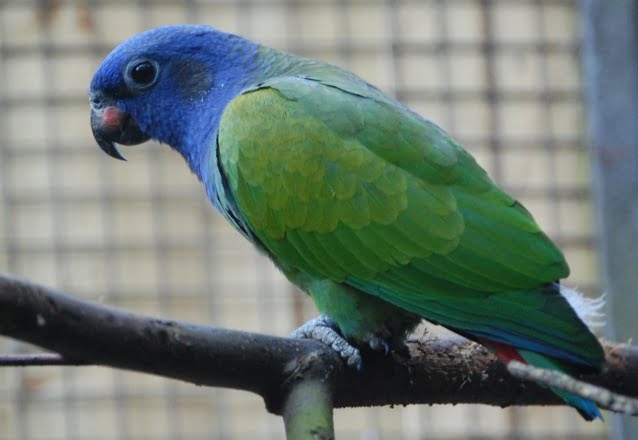
The Blue-headed Pionus (Pionus menstruus) is a stocky, mid-sized South American parrot: forest green through the body with a deep blue head and neck, and a red flash under the tail. Its main draw is temperament. Keepers describe it as calm and watchful, generally steadier than its brighter, louder cousins, and capable of being a companion for several decades when its needs are met. It notices routine and tone of voice, and it rewards a slow, consistent approach. It is also a genuine long-term commitment, and the results of care, good or poor, show up plainly in its feathers, weight and breathing.
History and Origin
In the wild, Pionus menstruus ranges across parts of Central America and northern South America. It is a bird of forested habitats and wooded edges, and it will also use cultivated areas where food is available, often staying high in the canopy and moving in small groups.3 That canopy-dwelling, flock-minded background is worth remembering, because the pet bird in your lounge room still carries the instincts of a social forager.
Appearance and Physical Characteristics
The Blue-headed Pionus is compact rather than long and sleek: broad through the body, with a short, squared-off tail and rounded wings. The blue head can look almost ink-dark in shade, then brighten in sun, while the green body carries subtle scaling and occasional yellowish edging depending on feather wear and the individual bird.1, 2 Adults typically sit in the 25 to 30 cm range and around the mid-200 grams, though healthy weights vary with frame size and activity. Excess weight is easy to miss under feathers.3, 4
- Typical length: about 25 to 30 cm
- Typical weight: roughly 230 to 300 g (varies by individual, diet and condition)
- Appearance: green body, deep blue head and neck, red under-tail coverts; dark brown iris and a pale eye-ring are common field marks
- Noise level: often described as moderate (with louder peaks around excitement and breeding season)
- Life span: commonly several decades in captivity when well managed; exact longevity varies widely with husbandry and veterinary care
Temperament and Personality
Steady and curious is the usual description. Blue-headed Pionus parrots are not typically as intense or demanding as some larger parrots, but they are very much social animals that track routine, tone of voice and the movement of people through a room. Many individuals prefer a slower approach and can be wary of sudden hands, towels and looming gestures. Noise is usually classed as moderate, but moderate still means a bird that calls, especially at dawn and dusk, during household commotion, or when in breeding condition.2
Is a Blue-Headed Pionus Right for You?
This is a parrot that suits a calm, consistent household willing to commit for the long haul, potentially decades. It is a good fit if you want a companion bird that is less loud and less needy than a larger parrot, and you can offer daily interaction, a proper diet and out-of-cage time. It is a poor fit if you want an instant, hands-on bird, or if a wary animal that needs patience to gain trust would frustrate you.
On legality: the Blue-headed Pionus is not a native Australian species, and Australia's rules on importing pet birds are strict. The Australian Government advises that pet birds can only be imported from New Zealand under specific conditions and permits, not from other countries.6 In practice that means a bird kept here should be sourced from established local aviculture rather than imported. Keeping and licensing requirements for non-native birds can also vary by state, so check your state or territory wildlife authority before you buy.
Care and Housing
Give this bird more room than the minimum. A cage large enough for full wing movement, plenty of out-of-cage time, and clean airflow do more for long-term health than any single accessory. Blue-headed Pionus are often described as relatively hardy, but hardy is not the same as low maintenance, and most preventable problems trace back to air quality, diet, chronic stress and missed early warning signs. A few high-value routines cover most of it:
- Weigh weekly (same scale, same time of day). A trend is more useful than a single number.
- Keep airflow clean: avoid smoke, aerosols, scented oils and dusty litter, and ventilate well.
- Clean smarter, not harsher: remove soiled substrate daily, wash bowls, and do a regular deeper clean of perches and bars.
- Book an avian vet check for baseline advice, especially after purchase or rehoming.
Breeding and Reproduction
In aviculture, Blue-headed Pionus typically nest in cavities, which means nest boxes in captivity. Clutch size is commonly reported around 3 to 4 eggs, with incubation roughly 24 to 26 days, and fledging often around 8 to 10 weeks, though individual pairs vary.3, 5 Breeding birds can also behave differently: increased territoriality, sharper body language, and in some pairs mate aggression. Management decisions such as nest box checks, enclosure layout and how you approach the birds can change outcomes for both bird welfare and keeper safety.2
Health and Lifespan
Well managed, a Blue-headed Pionus can live for many years, but its problems tend to arrive quietly rather than dramatically. The issues most commonly reported in Pionus parrots are worth watching for:
- Feather damaging behaviour (including feather picking), often multifactorial: diet, boredom, stress, skin irritation, pain or underlying disease.2
- Respiratory and systemic infections (bacterial or fungal), particularly where ventilation is poor or hygiene is inconsistent.2
- Nutritional disease (including vitamin A deficiency) where diets rely too heavily on seed and lack variety.2
- Obesity and inactivity, especially in smaller cages or with little out-of-cage movement.
The common thread is that early signs are subtle. Weight creeps up under the feathers, a routine never changes, a room stays a bit dusty, and the bird pays for it over time. Regular weighing and an established relationship with an avian vet catch most of this before it becomes serious.
Diet and Nutrition
A pet Blue-headed Pionus does best on a balanced base diet rather than an all-seed mix. In practice that usually means formulated pellets as the staple, with vegetables and some fruit offered daily, and seeds and nuts used more as training rewards and enrichment than as the main meal. Nutrition problems in parrots rarely arrive dramatically. They drift in quietly: too many energy-dense seeds, too little variety, and a bird that moves less because the cage is small or the day is predictable. Veterinary references for Pionus note conditions linked to diet and management, including vitamin A deficiency and poor eating habits, which is why a structured, consistent feeding plan matters.2, 3
Pionus parrots are natural foragers, so it helps to make food take a little work:
- Offer part of the daily ration in foraging toys or paper parcels.
- Rotate safe, destructible items (cardboard, untreated paper, soft wood) to encourage chewing.
- Use weighed portions if your bird is trending heavy. Parrots can gain weight without looking fat.
Training and Exercise
Quiet, consistent and reward-based is what works here. Short sessions are better than long ones, and a calm step up, stationing to a perch, and comfortable towel tolerance are more valuable than tricks. Keep the focus on choices and predictability: offer a hand, wait, reward the try. If the bird leans away, pins its eyes, or holds the body stiff and low, pause and give space. Trust builds in small increments.
A Few Things Worth Knowing
- Psittacosis is a real consideration. Also called parrot fever, it can spread to humans mainly through inhaling contaminated dust from dried droppings and secretions.7, 8
- Hygiene is the defence. Public health and agriculture guidance emphasises careful cleaning to reduce dust, using PPE such as a P2 respirator when appropriate, and getting prompt veterinary advice for a sick bird.8, 9
- Moderate noise is not no noise. Even a steady Pionus calls at dawn and dusk, so factor that into apartment living and shared walls.
The Bottom Line
The Blue-headed Pionus is a forest-coloured parrot with a sea-blue head: compact, capable, and often calmer than its brighter, louder cousins. Kept well, it can be a steady companion for many years. Kept poorly, the problems arrive quietly, a little too much seed, a little too little movement, a room that is a bit dusty, a routine that never changes. Start with the basics of diet, space, airflow, enrichment and an avian vet relationship, and the bird usually tells you the rest through its weight, feathers and posture.
References
- PionusParrot.com, Technical descriptions (Blue-headed Pionus)
- Susan Clubb, Blue-Headed Pionus species profile
- LafeberVet, Basic Information Sheet: Pionus (DVM-reviewed)
- PetPlace, Choosing a Blue-Headed Pionus
- Singing Wings Aviary, Blue-headed Pionus care notes (clutch, incubation and fledge figures)
- Australian Government Department of Agriculture, Fisheries and Forestry, Importing your pet bird
- Agriculture Victoria, Parrot fever (psittacosis) information
- Victoria State Government (Health), Psittacosis (ornithosis, parrot fever)
- NSW Health, Psittacosis fact sheet

Dog lover and writer at My Pets Australia, sharing practical breed guides and care advice for Australian pet owners.