Blue and Gold Macaw
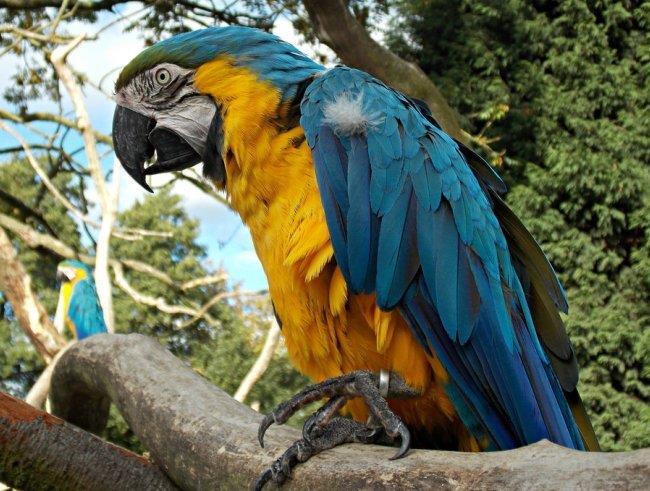
The blue-and-gold macaw (Ara ararauna) is one of the classic large parrots: nearly a metre of blue and yellow, a heavy beak built to crack hard nuts, and a mind that learns routines and tests boundaries. People love them for the colour, the intelligence, and the reputation as a talking parrot. It is also a serious commitment. A well-cared-for bird can pass fifty years, so this is a companion that may outlive a mortgage, and it needs space, noise tolerance and daily engagement to stay well. This guide covers what the bird is, where it comes from, and what it genuinely needs to live with you.
History and Origin
The blue-and-gold macaw, also called the blue-and-yellow macaw, is native to the Neotropics. It ranges widely through parts of Central and South America and also occurs on the island of Trinidad.1 In the wild it uses several habitat types, including forest edges, gallery forest and savanna-woodland mosaics, wherever there are tall trees for feeding and nesting hollows.2
In Australia it is not a wild bird. You may see blue-and-gold macaws in aviaries, sanctuaries and private collections, but any free-flying individual is an escapee rather than part of an established population.
Appearance and Physical Characteristics
This is a big, long-tailed, broad-winged parrot. Adults are typically about 81 to 86 cm from bill to tail tip, with much of that length in the tail, and weigh around a kilogram.1
Colour is the field mark: rich blue upperparts, bright yellow underparts and a greenish wash on the crown. The face is mostly bare white skin with fine black feather lines, a pattern that helps identify the bird at close range.1 The heavy black beak is a working tool designed to open hard nuts and seeds.
Temperament and Personality
Blue-and-gold macaws are highly social parrots, usually seen in pairs or small groups, with larger gatherings around food. In captivity they seek frequent interaction and can become loud, persistent or destructive when their days are predictable but unstimulating.
They can learn to mimic sounds, including some words, but talking ability varies widely between individuals. More reliable than speech is their talent for pattern-learning: routines, cause-and-effect games, and the quick association of your movements with their preferred outcomes, whether that is food, attention or access to a shoulder.
Noise and chewing are not behaviour problems. They are normal macaw traits. The voice is a long-distance signal system and the beak is built to demolish things. Expect:
- Daily periods of loud calling, often morning and late afternoon.
- Relentless chewing of timber, leather, soft metals, door frames and cabinetry.
- Strong opinions about routine changes, visitors and household movement.
Is a Blue and Gold Macaw Right for You?
For most households, honestly, no. This is a wide-ranging forest parrot that can outlive its owner's other pets by decades, screams by design, and will chew whatever it can reach. It suits an experienced keeper with time, space and genuine noise tolerance, ideally someone prepared for a companion animal measured in decades rather than years.
Many welfare problems come from good intentions paired with cramped cages, long hours alone, and a diet that is heavy on seed and light on variety. If you cannot offer room, daily interaction and a stable routine, this is the wrong bird.
Legality matters here too. Keeping a macaw in Australia can depend on state and territory law, and some birds require a licence or permit. Check your state or territory wildlife authority before you commit.
Care and Housing
Care is high in the ordinary, daily sense. This is a big parrot that needs room, structure and things to do with its beak. The practical essentials:
- Space: a large, sturdy enclosure plus daily time outside the cage in a bird-safe area.
- Enrichment: chewable toys, foraging opportunities, varied perches and rotated materials.
- Veterinary care: regular check-ups with an avian vet, and prompt attention to feather changes, appetite shifts or breathing noise.
- Bathing and feather care: many individuals benefit from frequent misting or showers.
Health and Lifespan
Blue-and-gold macaws are long-lived birds. Several decades is normal, and 50 years or more is realistic with excellent care. That lifespan is a defining part of the commitment: a young adult taking one on may be planning for the rest of their working life.
In the wild these macaws typically nest in tree cavities, including cavities in palms. They commonly lay two to three eggs, with incubation around 28 days, and chicks fledging roughly three months after hatching, though timing varies by conditions.1 Sexual maturity is generally reached between about three and six years of age.1 Breeding should be approached cautiously and ethically: parent birds need appropriate space, nutrition, veterinary oversight, and a plan for the long-term future of any chicks.
Diet and Nutrition
In the wild, blue-and-gold macaws feed largely on plant material: fruits, seeds and nuts. They take other items opportunistically, but the daily pattern is built around seasonal fruiting and the hard, energy-rich foods their beaks can open.1
A well-kept captive diet is varied and measured, not constantly seeded up. Avian veterinary guidance commonly recommends a base of quality formulated pellet with daily fresh foods, using nuts thoughtfully (often as training rewards) rather than as the bulk of the diet.3 The idea that these birds need a very high-fat diet is a common misconception. Macaws do use fats in nature, but captivity changes the equation: less flying, more reliable food and easy access. A balanced, vet-informed diet with controlled rich foods is safer than constant fatty mixes.3
Wild macaws are also known to visit clay banks. This behaviour, called geophagy, is generally understood as a way to obtain minerals (notably sodium) and, in some cases, to bind plant toxins eaten in unripe or defended seeds and fruits.4 It is a real behaviour, but it is not a substitute for good diet management in captivity.
A Few Things Worth Knowing
- A smaller cage is not fixed by attention. Interaction helps, but it does not replace physical space and daily movement. A macaw in tight quarters often redirects energy into screaming, pacing or chewing the cage itself.
- Even well-socialised macaws can bite. Hormones, fear, startle responses and frustration all play a part. Good handling reduces the risk but never removes the beak from the equation.
- The species is currently assessed as Least Concern globally, though local declines can occur where forests are cleared and trapping pressure is high.5 It is listed under CITES Appendix II, so international trade is regulated and requires appropriate permits and documentation.6
- It is a myth that this bird is listed as threatened under Australia's EPBC Act. That list is for native species and ecological communities, and the blue-and-gold macaw is not an Australian native.7 Trade and import rules can still apply through Australia's wildlife trade framework and biosecurity requirements.
- If you are dealing with a bird across borders, or considering importing one, Australia's requirements can involve both environmental permitting and biosecurity conditions, and they are specific about what can be imported and under what circumstances.8 Always check current federal and state or territory rules before making plans.
The Bottom Line
A blue-and-gold macaw is not a decorative pet. It is a wide-ranging forest parrot, built for flight, noise and hard foods, with a mind that notices patterns and tests limits. In the right home, meaning steady routine, space, enrichment and a careful diet, it can be a durable and fascinating companion for decades. In the wrong one, its talents turn inward, and the household will hear the difference.
References
- Birds of the World (Cornell Lab of Ornithology), Blue-and-yellow Macaw (Ara ararauna)
- Animal Diversity Web (University of Michigan), Ara ararauna
- MSD Veterinary Manual, Psittacine birds (husbandry and nutrition overview)
- Gilardi, J.D. et al. (1999) Science, "Biogeography of a specialized neotropical herbivore: chemical defense and clay consumption by parrots"
- IUCN Red List of Threatened Species, Ara ararauna (Blue-and-yellow Macaw)
- CITES, Ara ararauna listing (Appendix II)
- Australian Government DCCEEW, Threatened species under the EPBC Act
- Australian Government Department of Agriculture, Fisheries and Forestry, Importing your pet bird (biosecurity and permit pathway)

Dog lover and writer at My Pets Australia, sharing practical breed guides and care advice for Australian pet owners.