Barbary Dove
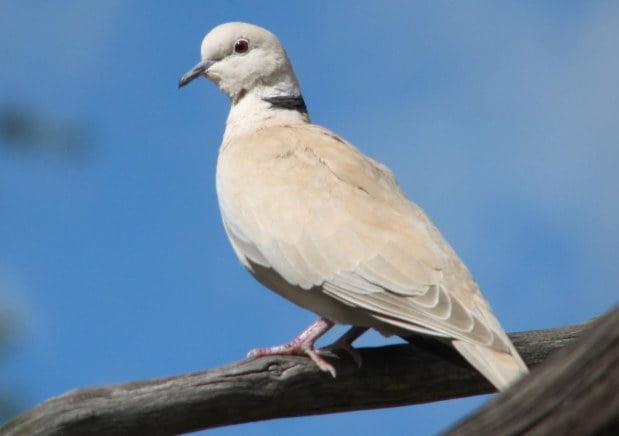
The Barbary Dove is a domesticated aviary dove, bred over many generations for a calm temperament and a soft, steady coo. It is a compact fawn-to-grey bird with the neat black half-collar that gives it the alternative name of ringneck dove. Keepers like it because it is quiet, undemanding, and content to potter about an enclosure feeding on the ground and resting on a perch. It is also one of the easier birds to confuse, because the collared doves people see in streets and parks are usually a different, wild species. This guide sets out what a Barbary Dove actually is, what it needs in captivity, and the plain biology behind the cooing.
History and Origin
The Barbary Dove is a domestic bird, selectively bred for colour and tameness rather than a species with a wild range of its own. In aviculture it is usually labelled Streptopelia risoria, and most modern summaries treat it as a domesticated form of the African Collared-Dove (Streptopelia roseogrisea), not the Eurasian Collared-Dove (Streptopelia decaocto).1, 2, 3
This is where the names cause trouble. A collared dove seen around shops, grain spills, and suburban streets, in Australia and North America alike, is usually the wild Eurasian Collared-Dove, which is widespread and listed as Least Concern globally.5 The wild ancestor of the pet bird, the African Collared-Dove, is associated with arid and semi-arid country, scrub, savanna, and areas near water, and it also turns up around farms and towns.3, 8
Appearance and Physical Characteristics
Barbary Doves are medium-sized, compact doves with a rounded head, a pale fawn-to-grey body, and the familiar narrow black half-collar on the hindneck. Adults are commonly around 25 to 27 cm long, and many sources place them at roughly 150 to 160 g, though this varies with strain and condition.3 Because people have selected these birds for looks over a long time, captive-bred lines come in a wide spread of colours, including white, pied, and tangerine.4
One thing worth correcting: doves are not swimmers. They will bathe, and a bird can float briefly in an emergency, but swimming is not a normal behaviour and should never be treated as a husbandry feature.
Temperament and Personality
In an aviary the Barbary Dove moves with quiet purpose, walking and feeding on the ground before lifting to a perch to rest. It is generally calm and tolerant, and it does best with a compatible mate or a steady companion rather than living alone for long stretches.7 These birds form strong pair bonds, and routine matters to them. Sudden changes, such as a new cage mate, a moved enclosure, or persistent disturbance, often show as subtle stress: less feeding, more hiding, or a bird sitting puffed for longer than usual.
Much of their communication is postural. The body held tall and still, head-bobbing during courtship, and a quick wing-flick when unsettled are all signals, best read in context alongside enclosure size, recent handling, and whether the bird can retreat to cover.
Is a Barbary Dove Right for You?
For someone who wants a gentle, low-key aviary bird and can commit to keeping at least a pair, the Barbary Dove is a genuinely good fit. It is quiet by bird standards, easy to feed, and long-lived. It is not a good match if you want a single bird for company on a desk or if you cannot provide an enclosure with room for real flight.
Before you commit, check the rules where you live. In Australia, ownership and any permit requirements for aviary birds can depend on state and territory law, so confirm the position with your state wildlife or agriculture authority. Local councils can also set rules on where enclosures go, how they are maintained, and how noise, smell, and vermin are managed.6
Care and Housing
For Barbary Doves, space is welfare. They do best in an enclosure that allows real flight, not just hopping between perches. Keep the structure dry, easy to clean, and predator-proof, with shade and a sheltered section that blocks prevailing wind and rain.7
The council side is consistent across most Australian areas: secure construction, regular cleaning, feed stored so it does not draw pests, and setbacks from boundaries and neighbouring dwellings.6 Good hygiene is not glamorous, but it changes outcomes. Keep litter dry and water containers clean, store feed where rodents cannot reach it, and quarantine any new bird before it joins an established pair or group.7
Diet and Nutrition
Doves are primarily seed-eaters. In practice that means a quality seed mix formulated for doves and pigeons, supplemented thoughtfully rather than constantly treat-fed, with clean water always available.7 The quiet essentials are what make the difference:
- Seed as the base, not bread and not kitchen scraps.
- Calcium support, especially for laying hens, commonly via cuttlebone, mineral blocks, or other bird-safe sources.
- Grit as appropriate for seed-eating birds, since it supports normal grinding of food in the gizzard.
If you are breeding, nutritional gaps show up quickly in egg quality, chick growth, and repeated clutches that leave hens run down.
Breeding and Reproduction
A typical dove nest is a simple platform of sticks, sometimes so minimal it looks temporary. Two white eggs are the norm, incubation is shared and usually runs around 14 to 16 days (often cited close to 15), and chicks fledge roughly two weeks after hatching under good conditions.3 In captivity these birds may breed opportunistically whenever food, water, daylight, and nesting sites make it easy.
That productivity is not always a benefit. If you do not want continuous breeding, manage nesting access and speak with an avian vet about safe options rather than letting repeated clutches deplete the birds.
Health and Lifespan
With good care, Barbary Doves are often cited as living up to around 12 years, and sometimes longer.4 Many dove illnesses look the same at first: a bird sits quietly, eats less, and breathes harder than it should. Respiratory disease and parasites are common concerns in captive pigeons and doves, and early action matters, because birds hide illness until they cannot.7
Seek prompt avian veterinary advice if you notice:
- tail-bobbing or open-mouth breathing
- wheezing, clicking, or wet sounds while breathing
- fluffed feathers and reluctance to move for more than a short rest
- watery droppings, weight loss, or repeated regurgitation
- crusts around the cere or nostrils, or swelling around the eyes
A Few Things Worth Knowing
- Names: Barbary Dove, ringneck dove, and Ringed Turtle-Dove all refer to the same domesticated bird in aviculture.1, 2, 3
- Clutch: almost always 2 eggs.3
- Not a wild species: because it is domesticated, the Barbary Dove is not assessed for conservation status. When people mention Least Concern, they usually mean a wild collared-dove species such as the Eurasian Collared-Dove.5
- Feral birds: escaped captive doves can turn up in the wild, but long-term self-sustaining populations are not reliable without human-provided food and shelter.8
The Bottom Line
The Barbary Dove is a calm, quiet, and long-lived aviary bird that suits keepers who can house it properly and keep it with company. Give it room to fly, a clean and predator-proof enclosure, a seed-based diet with calcium and grit, and an avian vet on hand, and it is an easy bird to enjoy. Just check your state and council rules first, and keep it as a pair rather than alone.
References
- Wikipedia, Barbary dove
- Wikipedia, Streptopelia (taxonomy notes include Barbary dove domestication context)
- Animal Diversity Web (University of Michigan), Streptopelia roseogrisea (African collared dove)
- Happy Hollow Park & Zoo, Domestic barbary dove
- IUCN Red List, Eurasian Collared Dove (Streptopelia decaocto)
- Logan City Council, Aviary birds (enclosure requirements and setbacks)
- RSPCA Australia Knowledgebase, Where should I keep my birds?
- Cornell Lab of Ornithology (All About Birds), African Collared-Dove life history
- Cornell Lab of Ornithology (All About Birds), Eurasian Collared-Dove life history

Dog lover and writer at My Pets Australia, sharing practical breed guides and care advice for Australian pet owners.