American Goldfinch
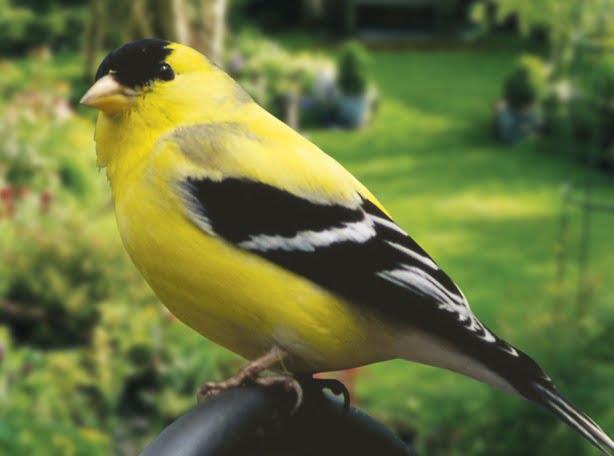
The American Goldfinch is a small North American finch best known for its summer colour: breeding males glow bright yellow with sharp black wings and cap. It is a common sight at feeders and in weedy fields, moving in nimble little flocks and calling as it goes. The catch is that it changes dramatically with the seasons, fading to a muted olive-brown in winter that looks almost like a different bird. That single fact is where most quick identifications go wrong. This guide covers size, plumage, calls, habitat, diet, breeding and migration, with practical notes for welcoming goldfinches into a garden.
American Goldfinch at a glance
- Scientific name: Spinus tristis1
- Size: 11 to 13 cm long; wingspan 19 to 22 cm; 11 to 20 g2, 3
- Typical look: Breeding male bright yellow with black wings and cap; females and winter birds more muted olive-yellow or brown with wingbars2, 3
- Diet: Mostly seeds (especially plants in the daisy family), commonly taken at feeders (sunflower, nyjer or niger)4, 5
- Where it lives: Weedy fields, forest edges, floodplains, farmland, parks and suburbs with seed-rich plants and scattered shrubs or trees4, 6
- Range: Widespread across much of North America, with short-distance or partial migration depending on region and winter food5, 7
- Conservation status: Least Concern (IUCN)8
Identification: what to look for
Goldfinches are small, neat finches with a short conical bill, long wings, and a short, notched tail. In flight they often show an undulating, buoyant pattern: rapid wingbeats followed by brief glides.2, 7
Male vs female (and the winter trap)
In the breeding season, adult males are unmistakable, with a bright yellow body, a black cap, and black wings marked with crisp white. Females are duller, more olive-yellow overall, and lack the bold black cap. Outside the breeding season both sexes can look surprisingly subdued, taking on browner or olive tones, yet the wingbars and finch shape still carry the identification.2, 3
Voice: calls you are likely to hear
American Goldfinches are chatty birds. A common call is a clear, high, rising-and-falling note often written as "per-chick-o-ree", along with thin, bright "tsee" notes as birds move between seedheads or feeders.5, 9
Habitat and distribution
The American Goldfinch thrives in open, seed-rich landscapes: weedy fields, roadsides, floodplains, early regrowth, farmland margins, and the patchwork of parks and backyards where thistles, asters and sunflowers are allowed to set seed. It typically needs a mix, with food plants out in the open plus shrubs or small trees nearby for shelter and nesting.4, 6
Across North America, presence shifts with season. Many birds move south in winter, while others remain farther north when seed supplies are good, so "migratory" is true but not uniformly so.7
Feeding habits and diet
American Goldfinches are strongly seed-focused. They favour small seeds from composite (daisy-family) plants such as thistles and sunflowers, and will also take seeds from grasses and certain trees. In some seasons they may add small amounts of insects and other plant material, but seeds are the centre of the diet.4, 6
They often feed in a nimble, acrobatic way, clinging to seedheads and working along stems rather than dropping to the ground for long. At feeders they readily use nyjer (niger) and sunflower seed, sometimes arriving in small flocks that drift through together.4
How to attract them to a garden
- Offer the right food: nyjer (niger) seed in a finch feeder; sunflower hearts or chips are also well used.4
- Let seedheads stand: keep some thistles, asters or sunflowers (or similar seed-bearing ornamentals) to mature and dry on the plant.4, 6
- Provide nearby cover: shrubs and small trees give quick shelter and nesting structure.6
Breeding and nesting behaviour
Goldfinches are notable for breeding later than many other songbirds, often timing nesting for mid-to-late summer when seed crops are abundant. This late schedule is closely tied to their seed-based diet, including feeding chicks largely on regurgitated seeds.10
Nests are typically placed in shrubs or small trees. The female does most of the nest construction, creating a compact cup from plant fibres and down, and laying a small clutch of pale bluish eggs. Parents feed the nestlings, and young fledge roughly two weeks after hatching (timing varies).10
Migration patterns
The American Goldfinch is best described as a partial, short-distance migrant. Northern birds commonly shift south for winter, while some populations remain year-round if conditions stay mild and food remains reliable. Movements can look irregular on the ground, with one winter a feeder is busy and the next it is quiet, because seed availability plays such a large role.7
Conservation status and common threats
Globally, the American Goldfinch is listed as Least Concern on the IUCN Red List, reflecting its broad range and large overall population.8
That does not mean local birds face no pressure. The familiar issues apply: loss of weedy field edges, heavy herbicide and pesticide use that strips seed sources, and predation at feeders and gardens, especially from roaming cats. Keeping feeding areas tidy and placing feeders near cover (but not directly in dense ambush spots) can help reduce risk.
State bird status: a quick correction
The American Goldfinch is the state bird of Iowa, New Jersey, and Washington. It is not the state bird of Wisconsin (Wisconsin's state bird is the American robin).5, 9
Notes for Australian readers
American Goldfinches are North American birds and are not part of Australia's wild birdlife. If you see a "goldfinch" in Australia, it is far more likely to be a different species (including introduced finches such as the European Goldfinch), so location and a local field guide matter for a confident identification.
References
- U.S. Fish & Wildlife Service, American Goldfinch (Spinus tristis)
- Cornell Lab of Ornithology (All About Birds), American Goldfinch Identification
- Animal Diversity Web (University of Michigan), American goldfinch (Carduelis tristis) account
- Cornell Lab, Celebrate Urban Birds: American Goldfinch
- Encyclopaedia Britannica, American goldfinch
- Animal Diversity Web (University of Michigan), Habitat notes for American goldfinch
- National Audubon Society, American Goldfinch field guide
- IUCN Red List of Threatened Species (search: Spinus tristis)
- Encyclopaedia Britannica, List of U.S. state birds
- New Hampshire PBS NatureWorks, American Goldfinch (life cycle and late nesting)

Dog lover and writer at My Pets Australia, sharing practical breed guides and care advice for Australian pet owners.