African Mourning Dove: Characteristics, Habitat, and Conservation
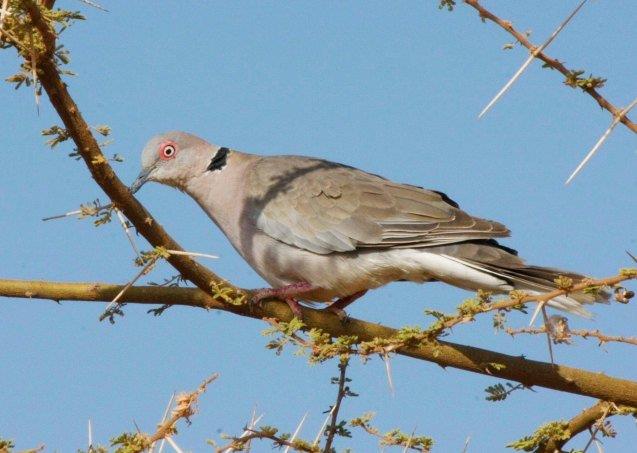
The African mourning dove, also called the mourning collared-dove, is a soft grey-brown dove of sub-Saharan Africa, best known for the dark half-collar on its nape and a rolling call that carries at dawn and late afternoon. Most people meet it near water or around a town edge and then want to know what it is and how to tell it apart from the many similar "ringneck" doves. The quickest clues are small: a patch of bare red skin around the eye, that dark collar, and the voice. It is a common, widespread bird rather than a rarity, and it is a wild African species, not something kept as a pet in Australia. If you are watching one in the field, a little attention to the head pays off.
Quick profile: African mourning dove (mourning collared-dove)
- Common names: African mourning dove; mourning collared-dove1, 2
- Scientific name: Streptopelia decipiens2, 3
- Range: Widespread south of the Sahara (resident breeder)2
- Typical habitat: Savanna and open woodland, especially near water; also around human settlement2, 4
- Conservation status: Least Concern (IUCN / BirdLife)2
Identification: what to look for in the field
The African mourning dove is a medium-sized, stocky dove with a grey head, buff-brown wings and back, and pinkish tones on the underparts. On the nape sits a black hind-neck patch edged pale, giving the collared look that links it to several close relatives.2
The most useful single clue is the bare red skin around the eye, often described as a red orbital ring. In good light it stands out against the softer plumage and helps separate the bird from similar ringneck doves.5
Size and measurements
Adults are often described as reaching about 32 cm in length, commonly in the high-20s to low-30s of centimetres depending on the source and population.2
Common lookalikes
- Cape turtle dove / ring-necked dove (Streptopelia capicola): overlaps in the half-collar pattern. Careful attention to the facial skin and overall tone helps, especially at waterholes where several species gather.5, 6
- Red-eyed dove (Streptopelia semitorquata): another common sub-Saharan species with a collar feature in the group, best separated with a full field-guide view of the head and eye and by voice.7
Habitat and distribution
The species is a widespread resident breeder across much of sub-Saharan Africa. It is often common or abundant near water, and it turns up in savanna and open woodland as well as around farms, towns, and gardens where feeding is reliable.2, 4
Behaviour and ecology
African mourning doves are usually seen as singles or pairs, though they will also feed in small groups where seed is concentrated on the ground. They are ground foragers, walking and pecking steadily through short grass, bare earth, and leaf litter for fallen seed and grain.2
Where conditions allow, pairs may stay together for long periods. As with many doves, the nest is typically a simple platform of twigs placed in a tree or shrub rather than elaborately woven.8
Diet
The diet is mainly seeds and grains taken from the ground. This keeps the birds tied to open patches such as track edges, grazed areas, and the scuffed margins of waterholes, where seed is exposed and easy to pick up quickly.2
Breeding
Clutches are typically two eggs, with both adults sharing incubation and chick care, a familiar pattern across many dove species.8
Conservation status
The African mourning dove is assessed as Least Concern. That does not mean pressures are absent, since local habitat change and water availability still shape where the birds thrive, but across its broad range it is not currently considered globally threatened.2
Notes on common misconceptions
- Not the North American mourning dove: despite the shared name, the African mourning dove is a different species and is not closely related to the North American mourning dove.2
- Collar details vary across "ringneck" doves: several African Streptopelia doves carry a similar dark nape patch. Eye-area skin colour and voice are often more decisive than the collar alone.5, 6
References
- eBird, Mourning Collared-Dove (Streptopelia decipiens) species profile
- BirdLife/IUCN summary (via Wikipedia), Mourning collared dove (Streptopelia decipiens)
- U.S. Fish & Wildlife Service, Mourning Collared Dove (Streptopelia decipiens)
- Animal Diversity Web, Streptopelia roseogrisea (habitat notes useful for comparison within collared doves)
- The Guardian (GrrlScientist), "Mystery bird: African mourning dove, Streptopelia decipiens" (ID note on red orbital ring)
- BirdLife/IUCN summary (via Wikipedia), Ring-necked dove / Cape turtle dove (Streptopelia capicola)
- BirdLife/IUCN summary (via Wikipedia), Red-eyed dove (Streptopelia semitorquata)
- Cornell Lab (All About Birds), Mourning Dove life history (clutch size and typical dove nesting pattern)

Dog lover and writer at My Pets Australia, sharing practical breed guides and care advice for Australian pet owners.