Pet Goliath Bird Eating Spider
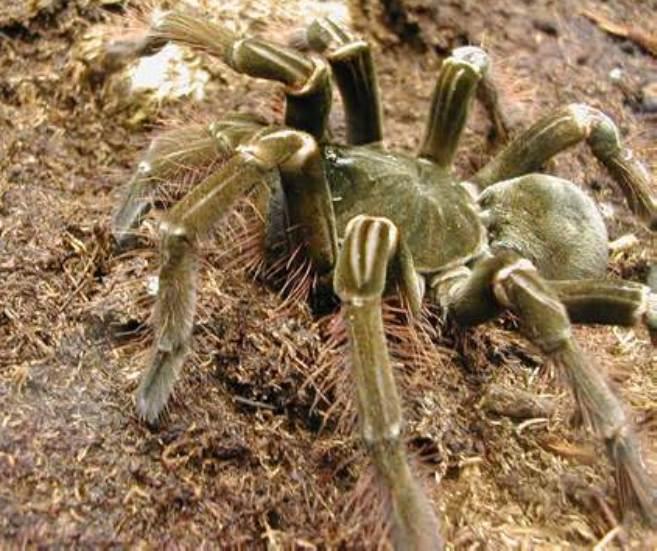
The Goliath birdeater (Theraphosa blondi) is the heaviest spider on Earth, a rainforest-floor hunter from northern South America that can reach a leg span of around 30 cm and a body mass near 175 g.1, 2, 3 For invertebrate keepers it is a spectacular display animal: patient, undemanding day to day, and genuinely impressive to watch. In Australia, though, the honest answer for most people is no. It is an exotic species that cannot legally be imported, so you cannot lawfully acquire or keep one here, and there is no legitimate supply chain that changes that. If you want a tarantula, look instead to the native species that can be kept where permitted, such as the whistling or barking spiders covered by the Australian Museum. What follows explains the animal itself, and why it draws so much attention.
Quick facts
- Scientific name: Theraphosa blondi1
- Adult size: commonly up to around 30 cm leg span in large individuals; documented record measurements are often in the high 20s cm2, 3
- Adult weight: up to around 170 to 175 g in very large specimens2, 3
- Lifespan: females often around 20 years; males commonly 3 to 6 years1, 3
- Range: northern South America (Amazon and Guiana Shield region)4
- Typical activity: mostly nocturnal, ground-dwelling, burrow-associated2, 4
What the name actually means
The name oversells the diet. T. blondi is capable of taking small vertebrates, and there are records of it eating birds, but most of its meals are invertebrates, with frogs, rodents and similar prey taken opportunistically when the chance arrives.1, 4 In the wild it is a stealthy, heavy-bodied hunter of the forest floor, far more likely to be found near a burrow than out in the open.2, 4
Appearance and Physical Characteristics
This is one of the largest spiders most people will ever see in person. By mass it is widely regarded as the heaviest spider on Earth, with very large individuals reaching roughly 170 to 175 g. Leg span is commonly quoted up to around 30 cm, though truly exceptional documented measurements tend to sit in the high 20s cm range.2, 3, 4 Colour varies with the individual and the lighting, generally brown to reddish-brown, with dense hairs (setae) that give it a velvety, bristled look. Those hairs are not just for show: some of them are part of its defence.
Temperament and Personality
Goliath birdeaters are not social animals, and they do not become tame. In captivity they are best treated as a display species, fascinating to observe but not suited to handling. When threatened, a tarantula may stand its ground, rear up and show its fangs as a warning, and if the warning is ignored it can bite.5
They have other defences too:
- Urticating hairs: like many New World tarantulas, they can kick barbed hairs from the abdomen. These can irritate skin and are especially troublesome if they get into the eyes or are inhaled.6
- Stridulation: some tarantulas produce a rasping, hiss-like sound by rubbing body parts together. It is a warning signal, not a sign of friendliness.4
Venom is used to subdue prey. For humans the bigger issues are usually the mechanical injury from large fangs, the pain of the bite, and secondary effects such as nausea in some cases. Any bite should be taken seriously, particularly if symptoms worsen or an allergic reaction is suspected.5
Care and Housing
T. blondi is a terrestrial burrower, so floor space, deep substrate and stable humidity matter far more than height or climbing features. The aim is a quiet, darkened forest-floor corner: damp but not swampy, with room to dig and a secure retreat.
The basics:
- Secure lid: essential. Not because they are fast like huntsman spiders, but because any escape in a home is a safety risk for both spider and people.
- Floor space: prioritise a wide enclosure that lets the spider turn and walk without constant wall contact.
- Substrate depth: deep enough to burrow and hold its shape; keep it slightly moist in the lower layers rather than wet on top.
- Hide: cork bark, a half-log or a starter burrow encourages calm, settled behaviour.
- Water dish: always available. Hydration should not rely on misting alone.6
For climate, aim for warm, stable conditions and moderate-to-high humidity, with good ventilation to avoid stagnant air. Overheating and constantly wet substrate are the common beginner errors: they raise stress and can encourage mould and bacterial growth. If supplemental heat is needed, it is generally safer to warm the room or use an external heat source rather than heating the substrate from underneath, which can drive a spider to burrow straight into the hottest zone.7
Diet and Nutrition
Despite the legend, routine feeding in captivity is straightforward: appropriately sized invertebrates. Large roaches, crickets and similar prey are common staples. Vertebrate prey is not necessary for routine care and adds risk, including injury to the spider, hygiene problems and ethical concerns.1, 4
A simple rule holds up well: do not offer prey larger than the spider can safely overpower, and remove any uneaten prey, especially around moulting time. Feeder insects should be clean and well fed so they are nutritionally worthwhile. Calcium supplementation, sometimes recommended for tarantulas, is usually misapplied; nutrition is better improved by gut-loading feeders and keeping the prey varied than by dusting it as though the spider were a reptile.
Handling
Even a calm tarantula can defend itself without warning, and a fall from hand height can be fatal to a heavy-bodied terrestrial species. The risk for keepers is not only venom: it is fangs, urticating hairs, and accidents during enclosure maintenance.5, 6
If you do need to move the spider (rehousing, deep clean, emergency):
- Use a catch cup or tub and a soft tool such as a paintbrush to guide it, not grab it.
- Work low to the ground, in a clear area.
- Consider eye protection and gloves if you react to the hairs or you are working in a confined space.6
Health and Lifespan
Most health problems trace back to husbandry rather than bad luck. Females often live around 20 years and males commonly 3 to 6, so a well-kept spider is a long commitment.1, 3
Moulting trouble is the big one. Moulting is normal but it is a vulnerable period, and dehydration, disturbance or feeder insects left in the enclosure can turn a routine moult into a crisis. A spider preparing to moult may refuse food and become reclusive; during the moult itself it should not be handled or helped. The best prevention is steady humidity, constant access to water, and removing live prey the moment the spider stops feeding.6
Dehydration shows as a weak, unsteady or unusually curled spider. The fix is usually simple husbandry: accessible water and sensible substrate moisture, not constant misting of the animal.
Mould, mites and dirty-enclosure problems follow from warmth and humidity speeding up decay. Remove food leftovers promptly, keep ventilation adequate, and avoid waterlogged substrate. Clean, stable conditions reduce the odds of secondary infections and pest build-up.
Breeding and Reproduction
Breeding T. blondi is not a casual project. It requires mature, correctly sexed animals, careful timing, and contingency plans for separation and rehousing. Egg-sac size varies, and sweeping claims like "up to 500 eggs" are not reliable as a general expectation; many sources instead describe clutches in the low hundreds for large tarantulas, with plenty of variation depending on the female and the conditions.4
Conservation Status and Legality
One widely repeated claim is wrong. This species is often said to be listed as "Least Concern" by the IUCN, but reputable references note that it has not actually been assessed by the IUCN Red List.4
Legality is the part that matters most for Australian readers. Australia's biosecurity and exotic-species rules are strict, and the Goliath birdeater is not a species you can legally import or keep here. Anyone offering one is operating outside the law. Always check your state and federal regulations before buying, selling or importing any invertebrate, and if you want to keep a tarantula, stick to the native species that are permitted where you live.
The Bottom Line
The Goliath birdeater is one of the most extraordinary invertebrates on the planet, and it earns its reputation on size and presence rather than personality. For Australian keepers, though, it is an animal to admire rather than own: it cannot be legally kept here, and the practical, ethical and legal path is a permitted native tarantula instead. If you ever do care for a large terrestrial tarantula somewhere it is legal, the formula is simple: keep it on its own, keep it warm and steady, keep water available, and keep your hands out of the enclosure unless there is a real reason to go in. That is where both keeper and spider do best.5, 6
References
- National Geographic, Goliath birdeater facts
- Guinness World Records, Largest spider (Theraphosa blondi)
- Natural History Museum (UK), What is the biggest spider?
- Encyclopaedia Britannica, Goliath birdeater (Theraphosa blondi)
- Australian Museum, Australian tarantulas (bite risk and handling cautions)
- Animal Learning, Tarantula care overview (handling risks, moulting guidance, humidity cautions)
- RSPCA, Advice on keeping invertebrates as pets
- National Geographic, World's biggest spider explained

Dog lover and writer at My Pets Australia, sharing practical breed guides and care advice for Australian pet owners.