Bees
Bees are among the most useful insects in any Australian garden, quietly doing the pollination work that keeps fruit setting and flowers reproducing. Most people meet them by accident: a swarm in the backyard, a garden that isn't fruiting, a child who has been stung, or a decision about whether to keep a hive. They are common, close to home, and easy to misunderstand. This is a plain look at what bees are, how honey bees and native bees differ here, what pollination actually does, and what genuinely threatens bee populations in Australia.
Bees at a glance
- Typical size: European honey bee workers are usually around 1 to 2 cm long, varying by caste and species.1
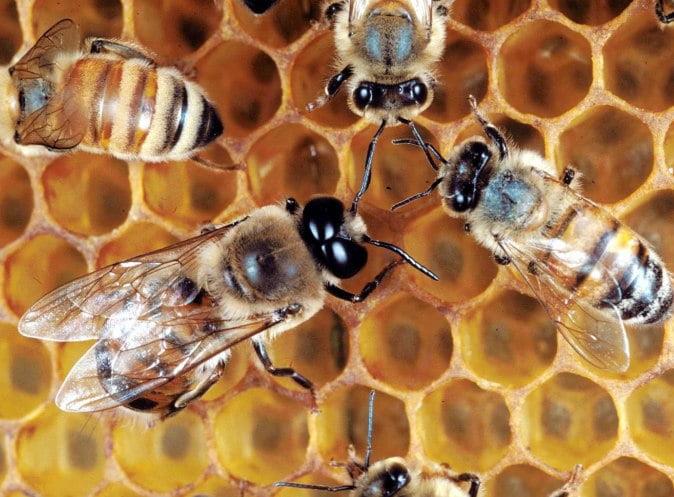
- Appearance: Many honey bees show bands of dark and amber or orange. Native bees vary widely and are not always striped.1, 2
- Diet: Nectar for carbohydrates, and pollen for protein and fats.2
- Home: Honey bees build wax comb inside cavities. Stingless native bees often nest in tree hollows and use wax and resin structures rather than open comb sheets.2
- Speed: Flight speed changes with wind, load and species, so it is best treated as variable rather than a single reliable number.
Honey bees and native bees are not the same thing
Australia has the introduced European honey bee (Apis mellifera) alongside a rich diversity of native bees, and the two are easy to confuse. Honey bees are the familiar hive-dwellers managed for honey and crop pollination, while most native bee species are solitary, nesting in soil, pithy stems, timber, or small crevices. A few native species are social, including the stingless bees (Tetragonula) found in warmer coastal regions.2
Stingless bees do store nectar and pollen, and they can produce a thin honey used as bush tucker. Their yields are small compared with honey bees, though, and the honey is different in taste and texture.2
Why bees matter, and what pollination actually means
Pollination is the transfer of pollen so plants can set seed and fruit, and bees are very good at it. They deliberately visit flowers for nectar and pollen, brushing past anthers and stigmas as they move. In Australian agriculture, bees underpin both crop yield and quality for many fruits, nuts and vegetables.3
In plain terms, fewer bees or fewer flower visits can mean smaller harvests, misshapen fruit, and a narrower range of plants successfully reproducing in a landscape. Exactly how much depends on the crop, the season, and which pollinators are present.
Life cycle and colony roles
A honey bee colony runs on division of labour. A single queen lays eggs, while most other females are workers that build comb, feed larvae, defend the nest and forage. Males, called drones, exist mainly to mate with queens. The details shift with season and conditions, but the overall pattern is steady: brood is raised continuously when resources allow, and the colony's workforce turns over as young bees mature.1
How bees communicate and find food
Honey bees can share information about profitable food sources using the waggle dance, a movement pattern that encodes direction and distance relative to the sun. It is not their only method, since odour cues and simple following behaviour matter too, but it is one of the best-studied examples of insect communication.4
Stingless bees do not perform the classic honey bee waggle dance. They commonly recruit nestmates using scent trails and other cues, especially at close to moderate distances.2
Threats to bees in Australia
Pesticides, especially mis-timing and drift
Bees can be harmed when insecticides drift onto flowering plants, water sources, or hives, or when residues stay toxic while bees are foraging. State agriculture departments consistently stress two practical controls: follow label directions, and communicate early so beekeepers can move or protect hives when spraying is planned.5, 6
Varroa mite
Varroa mite (Varroa destructor) is now part of the new normal for Australian honey bees. It weakens colonies over time and can contribute to colony failure if left unmanaged, and it can spread and amplify damaging viruses. This is primarily a honey bee problem, with serious knock-on effects for crop pollination and honey production.7
Habitat loss and thinner flowering seasons
Bees do not just need flowers, they need continuity. Urban development, land clearing, simplified plantings, and long gaps between flowering events reduce the steady flow of nectar and pollen that keeps colonies and solitary nests going. Drought and heat can stretch those gaps further.
Competition pressures, especially in cities
In some settings, high densities of managed honey bee hives can increase competition for nectar and pollen, potentially disadvantaging nearby native bees when floral resources are limited. The science is still developing and it is not a simple case of honey bees being bad, but it is a reason to think in terms of habitat and carrying capacity rather than adding hives by default.8
Backyard choices that actually help
- Plant for continuity: aim for something flowering in each season, mixing locally native plants with well-chosen ornamentals.
- Let some plants finish flowering: deadheading everything can remove food before it has been used.
- Avoid spraying open flowers: if you must treat pests, choose the least harmful option, follow the label closely, and time applications for when bees are not active.5, 6
- Provide clean water: a shallow dish with stones or floating corks gives bees a safe landing.
- Consider native bee habitat: patches of bare, undisturbed soil suit some ground-nesting natives, while others use small cavities in timber or stems.
Beekeeping: hobby, livelihood, and responsibility
Beekeeping can be deeply absorbing, but it is not set and forget. In a varroa-affected Australia, keeping honey bees means routine monitoring, biosecurity habits, and the willingness to act when thresholds are reached rather than hoping a colony will simply cope.7
In dense suburbs, it is worth pausing before adding hives. Sometimes the most helpful step is improving forage and nesting habitat for a wide range of pollinators, not just the one species that comes in a box.8
Honey and other bee products: what the evidence supports
Honey for coughs
For children over one year old, honey can modestly reduce cough symptoms from an acute upper respiratory infection compared with no treatment or placebo in the short term. Evidence quality varies, and honey is not a substitute for medical care when breathing is difficult or symptoms are worsening.9
Do not give honey to babies under 12 months
Honey should not be fed to infants under one year, because it can contain Clostridium botulinum spores that may cause infant botulism.10
Propolis, royal jelly and bee venom
These products are often marketed with broad health claims, but evidence varies by condition and preparation, and allergic reactions can be serious. Treat them as biologically active substances rather than harmless natural remedies, and seek qualified medical advice for any therapeutic use.
References
- Museums Victoria Collections, European Honey Bee (Apis mellifera) species profile
- Australian Museum, Stingless bee (Tetragonula)
- Australian Government Department of Agriculture, Fisheries and Forestry, Honey bees and pollination in Australia
- Encyclopaedia Britannica, Waggle dance (honey bee communication)
- Agriculture Victoria, Pesticides and honey bee poisoning
- PIRSA (South Australia), Pesticides and honey bee safety
- Business Queensland, Varroa mite: impacts and signs
- The Guardian, Scientists recommend limits on urban beekeeping to protect native bees (reporting on peer-reviewed research)
- Cochrane, Honey for acute cough in children (evidence summary)
- California Department of Public Health, Infant Botulism Treatment and Prevention Program: when to avoid honey

Dog lover and writer at My Pets Australia, sharing practical breed guides and care advice for Australian pet owners.