Birman Cat
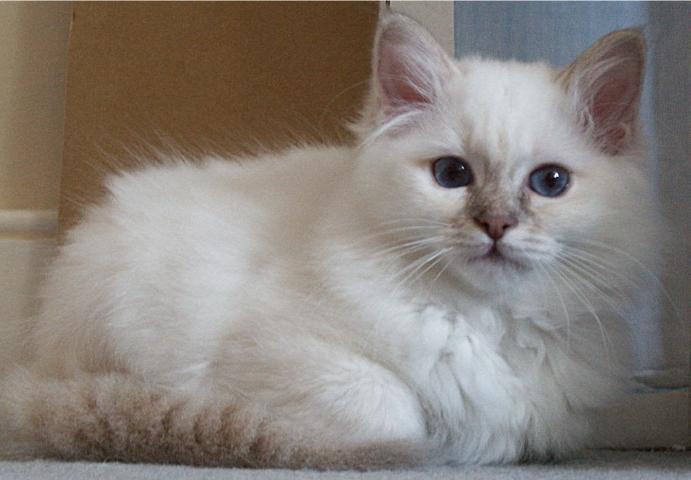
The Birman is a semi-longhaired cat known for three things: deep blue eyes, a colour-pointed coat, and four pure white feet that look like they have been dipped in paint. They are gentle, people-oriented cats that tend to stay near the household rather than vanish for the day, which makes them easy company. The coat is more manageable than it looks, and the temperament is generally calm and sociable. It is still a pedigree cat, though, which means there are inherited conditions worth raising with a vet and a breeder before you bring a kitten home.1, 2
Birman at a glance
- Look: colour-point coat (darker face, ears, legs and tail), deep blue eyes, and pure white feet ("gloves"), with white "laces" or "gauntlets" rising up the back legs.1, 3
- Coat: semi-longhair with a silky texture, typically less prone to matting than many longhaired breeds because it is a single coat with no dense undercoat.1
- Nature: generally people-oriented and gentle, and often sociable in a busy home when introduced thoughtfully.1, 2
History and Origin
The Birman is also known as the Sacred Cat of Burma, and temple legends are usually attached to the breed. Those stories are part of the folklore, but the documented modern history is clearer. Birmans were first recognised and shown in France in the 1920s, and the European population was rebuilt after World War II from a very small number of cats, with outcrossing used to recover the breed.1 It is best to treat claims like "ancient temple breed from Burma" as tradition rather than proven origin, and focus on what can be verified: the Birman we know today was developed and standardised in Europe through the 20th century.1
Appearance and Physical Characteristics
A Birman's outline is sturdy and balanced rather than extreme. The face is broad with a gentle "Roman" nose profile, the eyes are rounded and always blue, and the coat is colour-pointed, paler on the body and darker on the mask, ears, legs and tail.1
The signature detail is the white feet. Breed standards describe neat, symmetrical white "gloves" on the front paws and white "laces" or "gauntlets" on the back legs that taper to a point and should not extend beyond the hock.3, 4
Birman colours are presented as "point" colours, for example seal point, blue point, chocolate point and lilac point, with additional patterns recognised by some organisations (such as tabby or lynx, and tortie points). What is accepted can vary slightly by registry, so breeders and show exhibitors usually refer to the standard used in their state or association.4
Temperament and Personality
Birmans are commonly described as gentle, affectionate and comfortable around people. Many enjoy staying near the household rather than disappearing for hours, and they often cope well with respectful children and calm, cat-friendly dogs, provided introductions are slow and supervised.1, 2 They are also curious, and will usually take interest in whatever is happening at bench height: a drawer opened, a new box on the floor, a visitor's shoelaces. It is less about neediness than a preference for being part of the scene.1
Is a Birman Right for You?
Birmans suit homes that value calm routines and gentle interaction, with enough play and climbing to keep a bright mind occupied. They are sociable rather than demanding, which makes them a good fit for families and for households where someone is home a fair amount of the time.1, 2
The honest part is the ongoing commitment. This is a pedigree cat with a semi-longhaired coat, so you are signing up for regular grooming, dental care, weight management and vet visits across a long life. If you are buying a kitten, plan for health testing and slow, careful choosing rather than expecting "low maintenance" to mean "no maintenance".1, 7
Training and Exercise
Training a cat is mostly about shaping behaviour: rewarding what you want, making the unwanted behaviour unrewarding, and keeping sessions short. A Birman often picks up a routine quickly, whether that is sitting on the mat when the food cupboard opens, coming when called, or hopping into the carrier for a treat, because the rewards are clear and consistent.
For exercise, think in bursts: a wand toy, a short chase, a climb, a pause, then another round. Puzzle feeders and small "hunts" around the house add movement without turning your lounge room into a racetrack.
Health and Lifespan
No breed is problem free, and it is worth being cautious with long lists of conditions copied from the internet. For Birmans the most useful approach is specific: ask what your breeder tests for in their lines, and ask your vet what screening makes sense for your cat's age and history. Peer-reviewed research shows the Birman breed has relatively low genetic diversity compared with many other breeds, which is one reason responsible breeding practices and health testing matter.5
Inherited eye disease: PRA (rdAc) testing
One well-known inherited condition in Birmans is progressive retinal atrophy associated with the rdAc variant. Genetic testing can identify affected cats and carriers, which helps breeders reduce disease risk over time without narrowing the gene pool more than necessary.6
Keeping weight steady
Birmans can become overweight like any indoor cat, especially if calories are easy and activity is optional. Your vet can show you how to use a body condition score and set a feeding plan that suits a desexed adult metabolism, treat habits, and how much the cat actually moves each day.7
Grooming and Care
The Birman coat looks glamorous but is often more manageable than other semi-longhaired cats. A weekly comb-through is commonly enough for many individuals, with extra sessions during seasonal shedding to lift loose hair and reduce hairballs.1, 2
- Comb, do not rake: use a metal comb and work gently from the ruff and armpits through to the belly and tail, where tangles start.1
- Nails, ears, teeth: keep nails trimmed, check ears for debris or odour, and aim for regular toothbrushing with vet-approved toothpaste.1, 2
- Bathing: not routinely necessary for most Birmans unless your vet advises it for a skin or coat issue.2
Choosing a Breeder or Adopting
If you are buying a Birman kitten, look for evidence rather than reassurance. A good breeder can explain what they screen for, how they socialise kittens, and why they chose a particular pairing, without promising perfection.
- Ask what genetic tests are used in their lines (for example PRA or rdAc status) and whether you will receive written results.6
- Ask how kittens are raised (household noise, handling, other animals) and what support is offered after you take the kitten home.
- Expect a contract, desexing expectations, and clear welfare standards around breeding and showing.8
Not every Birman comes from a breeder. Adult pedigree cats and Birman-cross cats do appear in rescue, often when a household changes or a cat's care needs were underestimated. Temperament is individual, so spend time with the cat if possible, and ask the rescue group about health history, grooming tolerance, and how the cat copes with other animals. Microchipping is a basic safeguard whether you adopt or buy. It is a permanent form of identification, and it only works if your contact details stay up to date on the registry.9
The Bottom Line
A Birman is defined by small, precise details: the blue eyes, the white gloves, the soft-pointed coat, and the steady preference for company. They suit homes that value calm routines and gentle interaction, with enough play and climbing to keep a bright mind occupied.1, 2 If you are choosing a kitten, the safest path is slow and concrete: confirm health testing, meet the parents where possible, and plan for a lifetime of ordinary care, grooming, dental hygiene, weight management and regular vet visits.1, 7
References
- The International Cat Association (TICA), Birman breed information
- PetMD, Birman Cat Breed Health and Care
- Birman Fanciers Queensland, Judging Standard of the Birman Cat
- World Organisation of Cats, Standards: Sacred Birman (SBI)
- Lipinski MJ et al. (2008), The ascent of cat breeds: genetic evaluations of breeds and worldwide random-bred populations (Journal of Heredity)
- UC Davis Veterinary Genetics Laboratory, Progressive Retinal Atrophy (rdAc) genetic test information
- International Cat Care, Obesity in cats
- Australian Cat Federation (ACF), Responsible breeding and standards information
- RSPCA Australia, Microchipping

Dog lover and writer at My Pets Australia, sharing practical breed guides and care advice for Australian pet owners.